Electrodynamics: An Introduction Including Quantum Effects

With the realisation that light is nothing but electromagnetic radiation which reaches our eyes, it is clear that basic optical phenomena must also find their explanation in electrodynamics and hence in Maxwell's equations. The subject of this chapter is therefore the derivation of the well known laws of reflection and refraction of optics from Maxwell's equations. In subsequent chapters these will then be applied to metals, radio waves and wave guides. [*]
[*]A recommendable text to supplement this chapter, particularly with regard to more practical aspects, is R. Guenther, Modern Optics (Wiley, 1990).
Our procedure will be to arrive at the laws of optics from a consideration of the behaviour of an electromagnetic wave at the interface between two media. First, however, we recapitulate and summarise the essential continuity conditions and those of their validity for normal and tangential components of the fields, with indices (1) and (2) referring to two different media.
? D = ?. Here ? is the density of the "true" charges. With this equation we have:
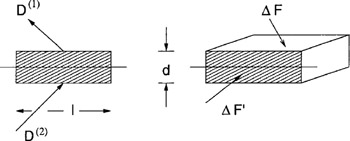
In the case of the infinitesimal volume element of thickness d ? 0 as shown in Fig. 11.1 we obtain from
d F (observe that in the limit d ? 0 the quantity ? F is an element of area in the boundary surface)
Figure 11.1: Elements of area and volume.
so...