Electrodynamics: An Introduction Including Quantum Effects

In the following we consider electromagnetic waves in vacuum and in media. This means, we first obtain the wave equations from Maxwell's equations and then obtain the very important vacuum relation already referred to in Chapter 1,
which determines the velocity of the electromagnetic wave in the vacuum (or more generally in a medium) as the reciprocal of the square root of the product of dielectric constant and magnetic permeability. One should note the difference to the case of Chapter 8, where the velocity was that of the wave in a transmission cable. We then investigate solutions in vacuum and in conducting media, and in the latter case we encounter the important skin effect.
In this case we have D = ? 0 E, B = ? 0 H, j = 0, ? = 0, since we consider first the case of electromagnetic waves without charges and currents (simply as a matter of simplicity we leave out the source terms here, considered to be far away). With these provisions we write down Maxwell's equations:
It is a general procedure to apply to the first two equations, which are " curl") equations, the curl operator once again in order to reduce them to Laplace form. This is achieved with the help of the formula
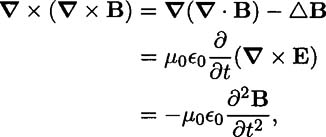
Applying this to the first equation and using the second, we obtain
i.e.
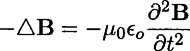
or
In the wave equation the parameter c obviously has...