Electrodynamics: An Introduction Including Quantum Effects
The crux of the Casimir effect [*] can already be explained with the help of the simple harmonic oscillator. In the case of the one-dimensional oscillator defined on z ? [ ? ?, ?] one obtains the ground state energy
, also called zero point energy, where ? is the frequency of the oscillator. If the oscillator is restricted to a domain x ? [ ? a,a], a large but finite, i.e. if the wave function ? is subjected to the boundary condition ?( a) = 0, the eigenvalues naturally change and become
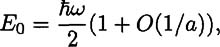
so that for a ? ? the zero point energy
is regained. Thus with the boundary condition one obtains a contribution ? 1/ a (or similar) to the energy, and hence a
Thus as a consequence of the boundary conditions, quantum mechanics implies a force proportional to 1/ a 2. The additional force derived from such a boundary-dependence in the case of quantised electrodynamics (in which conductors play the role of the walls at x = a in the above) is referred to as Casimir-effect.
In the following we introduce first the simple canonical quantisation of the n-dimensional harmonic oscillator. This method is then used to perform an analogous quantisation of the electromagnetic field which naturally implies divergences if the field is visualised as providing harmonic oscillators at every point in space. Thus the calculation...