Electrodynamics: An Introduction Including Quantum Effects

In this chapter we derive Maxwell's equations as the equations of motion of the electromagnetic field in spacetime in the customary way as the EulerLagrange equations derived from an action integral. We discuss gauge invariance, transversality and masslessness of the electromagnetic field and touch briefly (restricted by our predominantly classical topic here) its spin. Finally examples are given to illustrate the diversity of some recent explorations motivated by the Lagrangian of Maxwell electrodynamics.
We define as Lagrangian density the functional
We note that
is not
. Here A ?( x) is the electromagnetic 4-potential describing the local electromagnetic field. We define as Lagrangian the volume integral
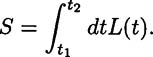
and as action or action integral
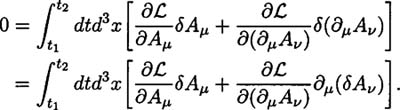
We demand that S or rather the Lagrangian density be a Lorentz invariant (recall we had verified previously the invariance of the spacetime (Minkowski space) volume element). The time dependence of L is implicitly contained in the fields. Our aim is, to derive the Maxwell equations in analogy to equations of motion in classical mechanics. Hence we construct an action to which we apply a Hamilton's principle. This means we demand that in varying the action by varying the fields A ?( x) and their derivatives ? ? A v( x) at fixed endpoints, this action is to remain stationary. Thus we demand
with
Hence
As in classical mechanics one varies with respect to a parameter ?,...