Electrodynamics: An Introduction Including Quantum Effects

In this chapter we extend the previous considerations to dielectric media (generally with negligible conductivity). This leads to the consideration of the polarisation of these media and their macroscopic effects, the most prominent concept introduced here being that of the dielectric displacement D.
So far we considered point charges, for which the following equations hold:
Here, as in our previous considerations, E and ? are constant in time. In macroscopic dimensions, yet in a small volume, the number of charge-carrying particles is of the order of (say) 10 18, most of which are in microscopic motion. In the context of macroscopic electrostatics we consider only such cases which are macroscopically static, i.e. without an observable change in time. This means we assume that all fluctuations in space and time taking place microscopically average out such that they leave no effect macroscopically. Thus we again assume the charge distributions and fields to be time independent. Later it will be a decisive step to assume that the equations of electrostatics hold also for time dependent cases. We define the mean values
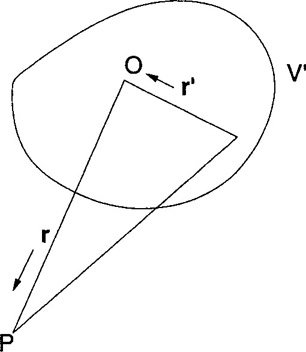
Here V ? is as shown in Fig. 4.1 the volume containing the molecules.
We imagine the field E with definite direction directed from a charge + q to a charge ?4. If we place charges or charged particles into this field the positive charges will be...