Electrodynamics: An Introduction Including Quantum Effects

Chapter 15: Propagation of Waves in Media

15.1 Introductory Remarks

In this chapter we introduce the concepts of signals and wave packets and demonstrate the intricate connection between the analytic properties of the Fourier transform of the wave packet (also called its spectral function) and the limitation of its velocity by the velocity of light.

15.2 Dispersion Relation: Normal and Anomalous Dispersion

In preceding chapters we derived and became familiar with the dispersion relation of a conducting medium, i.e.


which also defines the generalised dielectric constant ? (one should note that in general the relation is more complicated, in particular, as we saw in Chapter 9, if the frequency dependence of the conductivity ? is taken into account). We arrived at the expression (15.1) by assuming


together with the two Maxwell curl equations, and we obtained


The relation (15.1) is a general consequence if we assume that H does not vanish anywhere in space. We now want to study the dispersion relations as functions of the frequency ?.

We had also defined previously the generalised refractive index


so that


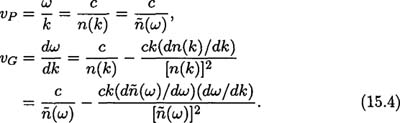
The phase velocity u P and the group velocity v G defined previously for real n( k) or ( ?) are given by


Solving the latter for d ?/ dk we obtain


One says, there is no dispersion if d ( ?)/ d ? = 0.

We now distinguish between two cases:

  1. The case of normal dispersion defined by


    (in general ?/

UNLIMITED FREE
ACCESS
TO THE WORLD'S BEST IDEAS

SUBMIT
Already a GlobalSpec user? Log in.

This is embarrasing...

An error occurred while processing the form. Please try again in a few minutes.

Customize Your GlobalSpec Experience

Category: Particle Analyzers
Finish!
Privacy Policy

This is embarrasing...

An error occurred while processing the form. Please try again in a few minutes.