14.9.1 The Complex Poynting Vector
In our earlier treatment of the Poynting vector we always assumed real quantities. We now wish to allow for complex fields, and complex ?, ?.
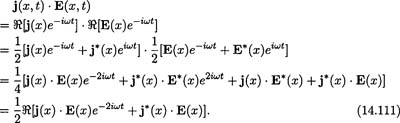
For the calculation of the transport of energy in wave guides we consider as a first step time averaged products of real vectors, which result from complex vectors and lead to the definition of the complex Poynting vector. This complex Poynting vector takes into account loss of energy due to complex ? and ?. Consider the real product, [ ] in which we again separate the time dependence with the factor e ? i ? t:
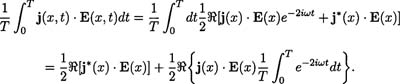
The time average of this is (averaged over one oscillation period T = 2 ?/ ?)
However
Therefore
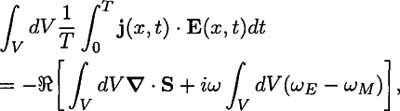
Next we consider this expression integrated over a spatial volume V, i.e.
In this foregoing step we replaced j by the Maxwell equation
and to go to the next line we use
so that we obtain
Here we use the Maxwell equation
and obtain the expression
One now defines the complex Poynting vector
and the complex energy densities
Hence we obtain
or
This result is to be compared with the expression we had earlier. The minus sign in the second contribution originates from the appearance of j* (instead of j) in the preceding line. In the case of lossless conductors (i.e. with no damping) or dielectric media...

 TABLE OF CONTENTS