Electrodynamics: An Introduction Including Quantum Effects

In the case of resonators or cavities we have additional boundary conditions at values of z, where the two ends of the resonator have their closures, and the boundary conditions there supply a third integer (recall that our considerations in Sec. 14.6 with the enforcement of boundary conditions, led to wave guide modes characterised by two integers). All these integers arise in analogy to quantum numbers in quantum mechanics, there each corresponding to quantisation of one degree of freedom. Here, of course, we are dealing with macroscopic physics, and the analogy is restricted to that of the mathematical eigenvalue problem. We assume that the cylindrical resonator is closed at both ends by plates made of the same conductor material as the body of the resonator. The electromagnetic waves can now also be reflected at the two ends.
We begin with TM modes, with time-dependence e ? i ? t (as before). In this case we have B z = 0 (everywhere), and we make the ansatz
As before we obtain the transverse components from the relations derived earlier, i.e. Eqs. (14.20) and (14.21), and hence here, with ? 2 = ? ? ? 2 ? k 2, from
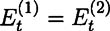
In view of the general boundary condition
we have at the ends: Inside E ? = 0 for ideal conductors.
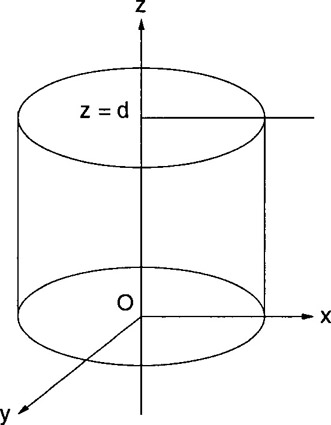
Hence we have, with the geometry of the resonator as shown in Fig. 14.11,
and hence