Electrodynamics: An Introduction Including Quantum Effects
Chapter 7: The Maxwell Equations

7.1 Preliminary Remarks

Now that we have dealt with electrostatics and magnetostatics also for macroscopic objects, the next step is to introduce time dependence. Proceeding in our phenomenological and historical approach we are led to consider next Faraday's law of induction. With this we can complete the equations of macroscopic electrodynamics with the addition of Maxwell's displacement current. The result is the full set of Maxwell's equations.

7.2 Time-Dependent Fields and Faraday's Law of Induction

Faraday discovered in 1831 that an electric current arises in a closed wire loop if the wire is moved through a magnetic field, in other words when the position or orientation of the wire with respect to the magnetic field is changed, or if the magnetic field varies with time. We consider two situations in which Faraday's observation applies. In the first case the field B is maintained constant in time.

  1. In an electric field E the charge q experiences the force


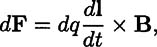
    This force F results from a nonvanishing potential difference in the conductor. On the other hand (cf. Lorentz-force), the field B acting on a charge dq moving with velocity v = d l/ dt implies that the latter experiences the force d F given by


    so that


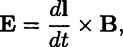
    Identifying the forces of Eqs. (7.1) and (7.2) in order to arrive at an explanation of Faraday's observation, we obtain


    i.e.


    provided the right side (or one component) is parallel to E. This...

UNLIMITED FREE
ACCESS
TO THE WORLD'S BEST IDEAS

SUBMIT
Already a GlobalSpec user? Log in.

This is embarrasing...

An error occurred while processing the form. Please try again in a few minutes.

Customize Your GlobalSpec Experience

Category: Electrical Power Generators
Finish!
Privacy Policy

This is embarrasing...

An error occurred while processing the form. Please try again in a few minutes.