Electrodynamics: An Introduction Including Quantum Effects
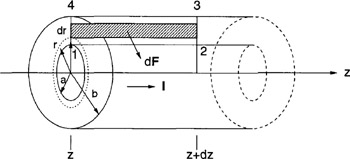
We mentioned already previously that the investigation of properties of wave guides can also be carried out by focusing on the induced charges and currents, i.e. we infer from the fields E and H the presence of charge q and current I, described as induced, which are the same as those which give rise to the fields E and H. We now derive the corresponding equations. These describe the propagation of the potential difference or voltage V = V( t, z) and the current I = I( t, z) along the cable. The equations that we obtain, are more general than our derivation here, and retain their validity for many other types of wave guides. Thus we consider a coaxial cable with radii a, b (with a < b). We let V( t, z) be the voltage between the outer and the inner cylinders at z-coordinate z, and we let I( t, z) be the current induced in the inner cylinder (or the current corresponding to an appropriate surface current). Then we know that at distance r with r > a, from the axis of this cylinder, as indicated in Fig. 14.2, the magnetic field strength H is given by
as may be verified, for instance, by referring back to Example 8.2.