14.6.1 General Considerations
We first demonstrate that TM and TE waves are not transversal, i.e. they do possess longitudinal components. In the cases of TE and TM waves the expressions for E ? and B ? in Eqs. (14.20) and (14.21) also simplify. Setting
we obtain from Eqs. (14.20) and (14.21) for ? 2 ? 0:
TM: B z = 0 everywhere,
TE: E z = 0 everywhere,
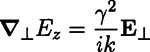
TM: Inserting in the second of Eqs. (14.67) the expression for ? ? E z from the first of Eqs. (14.67), we obtain
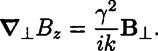
TE: Inserting similarly in Eqs. (14.68) the expression of the equation for ? ? B z into the other, we obtain
We conclude: E z, B z ? 0, because from Eqs. (14.67) for TM
and from Eqs. (14.68) for TE
Thus the components E z (TM), B z (TE) are not both zero; i.e. the TM and TE waves are not transversal waves, they possess longitudinal components E z and B z.
We saw previously (see Eqs. (14.30)), that E( x, y), B( x, y) satisfy the equations
(i.e. for each of the three components of E and B). We have therefore in particular for the z-components
TM:
TE:
Equations (14.72) and (14.73) together with their boundary conditions define an eigenvalue problem for the determination...


 TABLE OF CONTENTS