Electrodynamics: An Introduction Including Quantum Effects
In the following we study moving charges in a vacuum, i.e. we consider the Maxwell equations with nonvanishing charge density (hence also with nonvanishing current density). We investigate the solutions of the wave equations and thus obtain potentials and fields. Finally we consider the radiation of an oscillating dipole (consisting of two charges). In particular we shall see that accelerations of charges produce the dominant field contributions at large distances (called " radiation fields") and that these are mutually orthogonal. These considerations are of eminent importance for an understanding of electrodynamical phenomena, also because the dipole is often referred to as a kind of idealised classical model of an atom and thus offers the explanation why this picture is wrong - the dipole radiates off energy and exhausts itself therewith.
Here D = ? 0 E, B = ? 0 H, so that Maxwell's equations become
and
and
Expressing B in terms of the vector potential A, we have
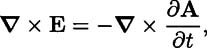
and from Eq. (10.1) we have
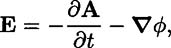
i.e.
as already familiar. With ? E = ?/ ? 0 we obtain
and with Eq. (10.2) we obtain
Equation (10.3) reduces to
and Eq. (10.4) to
where ? 0 ? 0 = l/ c 2.
We have seen earlier that the observable fields E and H are independent of the particular choice or gauge of the vector potential. Previously,...