Low Power Methodology Manual: For System-on-Chip Design
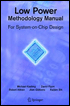
Taking a practical approach, rather than a theoretical approach, this book describes a number of the techniques designers can use to reduce the power consumption of complex SoC designs.
 TABLE OF CONTENTS
 The techniques discussed in the previous chapter are mature; engineers have been using them for some time, and design tools have supported them for years. With this chapter, we begin discussing more recent and aggressive approaches to reducing power: power gating and adaptive voltage scaling.
Both of these techniques rely on moving away from the traditional approach of using a single, fixed supply rail for all of the (internal) gates in a design. (IO cells have had a separate power supply in most chips for many years).
The most basic form of this new approach is to partition the internal logic of the chip into multiple voltage regions or power domains, each with its own supply. This approach is called Multi-Voltage design. It is based on the realization that in a modern SoC design, different blocks have different performance objectives and constraints. A processor, for instance, may need to run as fast as the semiconductor technology will allow. In this case, a relatively high supply voltage is required. A USB block, on the other hand, may run at a fixed, relatively low frequency dictated more by the protocol than the underlying technology. In this case, a lower supply rail may be sufficient for the block to meet its timing constraints and a lower supply rail means that its dynamic and static power will be lower.
Once we have crossed the conceptual barrier of having separate supplies, there are more complex power strategies we can contemplate: we can provide...