Low Power Methodology Manual: For System-on-Chip Design
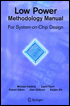
Taking a practical approach, rather than a theoretical approach, this book describes a number of the techniques designers can use to reduce the power consumption of complex SoC designs.
 TABLE OF CONTENTS
 This chapter describes the syntax for selected UPF commands referenced in the text.
Excerpts from the "Unified Power Format(UPF) Standard, Version 1.0" reproduced by permission of Accellera. Copyright(c) 2006 2007 by Accellera. Accellera does not warrant or represent the accuracy or content of the excerpted material, and expressly disclaims any express or implied warranty. Accellera Standards excerpts are supplied "AS IS."
The full standards document in its entirety can be found under www.accellera.org.
| Purpose | Define the states of each of the supply nets for one possible state of the design | |
| Syntax |
<b class="bold">add_pst_state</b> <i class="emphasis">state_name</i> <b class="bold">-pst</b> <i class="emphasis">table_name</i> <b class="bold">-state</b> <i class="emphasis">supply_states</i> | |
| Arguments |
<i class="emphasis">state_name</i> | The power state. |
|
<b class="bold">-pst</b> <i class="emphasis">table_name</i> | The power state table (PST) to which this state applies. | |
|
<b class="bold">-state</b> <i class="emphasis">supply_states</i> | The list of supply net state names, listed in the corresponding order of the -supplies listing in the create_pst command. | |
| Return value | Return a 1 if successful or a 0 if not. |
The add_pst_state command defines the states of each of the supply nets for one possible state of the design.
It is an error if the number of supply_state_names is different than the number of supply nets within the PST.
Syntax example:
create_pst pt -supplies { PN1 PN2 SOC/OTC/PN3 }add_pst_state s1 -pst pt -state { s08 s08...