
Pinion Metric Gears
Description
Pinion metric gears are mechanical components used to transmit rotary motion. They are characterized by their metric sizing, which is increasingly used worldwide. These gears are integral in systems where precise motion control is required, such as in rack and pinion setups, where they engage with a linear gear (rack) to convert rotational motion into linear motion.
Working Principle
Pinion metric gears work by meshing with another gear or a rack to transmit motion and force. The teeth of the pinion engage with the teeth of the rack or another gear, allowing for the conversion of rotational motion into linear motion or vice versa. This mechanism is particularly useful because it provides a positive motion, meaning there is no slippage, which is crucial for applications requiring precise control. The efficiency of power transmission is determined by the diameter of the pinion and the number of teeth engaged, which affects the smoothness of the operation.
Applications
Pinion metric gears are used in a variety of applications. In industrial settings, they are found in drill press spindles and lathe beds. In construction, they are used to move temporary elevators. A notable application is in the steering mechanisms of vehicles, where they provide precise control and feedback. Additionally, in rack and pinion railways, they enable trains to ascend steep slopes by engaging with a central rack between the rails.
Advantages over other Manufacturing - Cleaning and Surface Preparation
Pinion metric gears, particularly those with ground teeth, offer a precise fit and smoother operation compared to other gear types. This precision in manufacturing allows for increased power transmission efficiency and reduced noise and vibration during operation. The hardened teeth of these gears also contribute to their durability and longevity, making them a preferred choice in applications where reliability is critical.
Limitations
One limitation of pinion metric gears is that they provide less mechanical advantage compared to other mechanisms. This can be a disadvantage in applications where maximizing force output is necessary. Additionally, the precision required in their manufacturing can lead to higher initial costs compared to simpler gear systems.
Considerations
When considering pinion metric gears, it is important to account for initial costs, which can be higher due to the precision manufacturing required. Operating expenses may also be influenced by the need for regular maintenance to ensure accuracy and longevity. Durability is generally high, especially for gears with hardened and ground teeth, but replacement and maintenance costs should be factored into the overall cost of ownership. The choice of material, such as steel or aluminum, can also affect the gear's performance and cost.
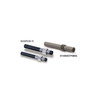
from Stock Drive Products & Sterling Instrument - SDP/SI
You May Also Need: Shafts. Bearings. Couplings. In a gear train, the pinion shaft transfers applied force to the gears in the train. To increase their ability to tolerate more torque, we machine the pinion into a single piece of shafting. Material: 303 Stainless Steel [See More]
- Gear Type: Spur; Rack; Pinion
- Pressure Angle: 20°
- Number of Teeth: 10
- PD: 5
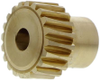
from RS Components, Ltd.
Pinion Gear 0.8 module 2 starts 20 teeth [See More]
- Gear Type: Pinion
- PD: 16.11
- Number of Teeth: 20
- Face Width: 18
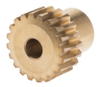
from RS Components, Ltd.
Pinion Gear 0.8 module 1 start 20 teeth [See More]
- Gear Type: Pinion
- PD: 16.03
- Number of Teeth: 20
- Face Width: 18
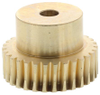
from RS Components, Ltd.
Pinion Gear 0.8 module 1 start 30 teeth [See More]
- Gear Type: Pinion
- PD: 24.04
- Number of Teeth: 30
- Face Width: 18
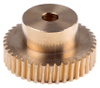
from RS Components, Ltd.
Pinion Gear 0.8 module 1 start 40 teeth [See More]
- Gear Type: Pinion
- PD: 32.05
- Number of Teeth: 40
- Face Width: 18
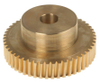
from RS Components, Ltd.
Pinion Gear 0.8 module 1 start 50 teeth [See More]
- Gear Type: Pinion
- PD: 40.06
- Number of Teeth: 50
- Face Width: 18
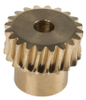
from RS Components, Ltd.
Pinion Gear 1.0 module 2 starts 20 teeth [See More]
- Gear Type: Pinion
- PD: 20.16
- Number of Teeth: 20
- Face Width: 20
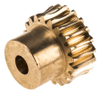
from RS Components, Ltd.
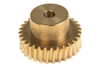
Pinion Gear 1.0 module 1 start 20 teeth [See More]
- Gear Type: Pinion
- PD: 20
- Number of Teeth: 20
- Face Width: 14.5
from RS Components, Ltd.
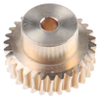
Pinion Gear 1.0 module 2 starts 30 teeth [See More]
- Gear Type: Pinion
- PD: 30.24
- Number of Teeth: 30
- Face Width: 20
from RS Components, Ltd.
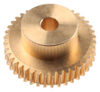
Pinion Gear 1.0 module 1 start 30 teeth [See More]
- Gear Type: Pinion
- PD: 30
- Number of Teeth: 30
- Face Width: 16.5
from RS Components, Ltd.
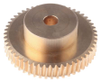
Pinion Gear 1.0 module 1 start 40 teeth [See More]
- Gear Type: Pinion
- PD: 40
- Number of Teeth: 40
- Face Width: 16.5
from RS Components, Ltd.
Pinion Gear 1.0 module 1 start 50 teeth [See More]
- Gear Type: Pinion
- PD: 50
- Number of Teeth: 50
- Face Width: 20

from Ondrives.US Corporation, formerly Rino Mechanical
Ondrives.US has been designing, engineering, and manufacturing gears, gearboxes, and other motion transfer components for decades. If none of our standard gear options are right for your application, we can produce custom gears that meet your specifications. We can work from your part prints, or... [See More]
- Gear Type: Spur; Helical; Worm; Worm Wheel; Rack; Pinion
- Features: Anti-backlash

from Shenzhen Besta Precision Machinery Co., Ltd.
Rack and pinion is utilized to convert rotational motion to linear motion. A rack is straight teeth cut into one surface of rectangular or cylindrical rod shaped material, and a pinion is a small cylindrical gear meshing with the rack. There are many ways to categorize gears. If the relative... [See More]
- Gear Type: Rack; Pinion
- Pressure Angle: 20°
- Number of Teeth: 30 to 300
- Features: Rack/Rail
from QTC METRIC GEARS
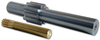
Circular Pitch 10 - 10 Tooth Ground Steel Pinion Shaft [See More]
- Gear Type: Pinion
- Pressure Angle: 20°
- Number of Teeth: 10
- PD: 31.83

from ATLANTA Drive Systems, Inc.
Welcome to the widest range of standard racks & pinions in the World! Consisting of both helical & straight (spur) tooth versions, in an assortment of sizes, materials and quality levels, to meet almost any axis drive requirements. These drives are perfect for a wide range of applications,... [See More]
- Gear Type: Spur; Pinion
- Pressure Angle: 20°
- Number of Teeth: 25
- Features: Ground Teeth; Anti-backlash (optional feature)

from ATLANTA Drive Systems, Inc.
We have recently expanded our range of ISO 9409-1-A flanged pinions. This allows the machine designer the flexibility of choosing the best flanged pinion to meet the application needs. The new TR flanged pinions have compact designs to reduce the amount of drive torque required. Traditionally,... [See More]
- Gear Type: Helical; Pinion
- Direction: Left
- Number of Teeth: 12
- Pressure Angle: 20°
from ATLANTA Drive Systems, Inc.
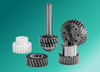
Welcome to the widest range of standard racks & pinions in the World! Consisting of both helical & straight (spur) tooth versions, in an assortment of sizes, materials and quality levels, to meet almost any axis drive requirements. These drives are perfect for a wide range of applications,... [See More]
- Gear Type: Helical; Pinion
- Direction: Left
- Number of Teeth: 30
- Pressure Angle: 20°