
Foam Cores Information
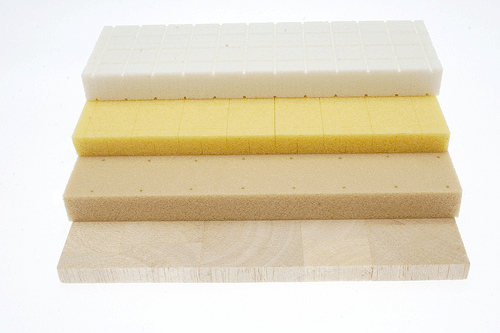 Foam cores and foam core materials are low density, high porosity materials used between structural skins to form a cored laminate with increased stiffness. Industrial foams consist of low density elastomers, plastics, or other materials with internal open or closed porosity.
Specifications
Cores may be made from closed cellular, open cellular, rigid, or syntactic foam types. Closed cellular foam cores have pores or cells that are not interconnected and that are sealed off to an external surface. These foams are useful for buoyancy and flotation applications. Open cellular foam cores feature cells that are interconnected and open to an external surface. Open cell foam cores are useful for filtration applications. Foam cores may also be made from rigid foam materials that offer little-to-no flexibility. They may also be composed of syntactic foams that consist of rigid microspheres that are held together by plastic or resin matrix.
There are also many options for foam core polymer/chemical systems, including ethylene copolymer, expanded polystyrene, expanded polyethylene, polyester, polyether, polyimide, polyolefin, polypropylene, phenolic resin, polyisocyanates, polyurethane, vinyl or PVC, and other speciality compositions. Foam cores may also be filled for reinforcement, thermoset/crosslinked, or undergo thermoplastic softening and hardening. Other materials and options may also be available for foam cores.
Applications
Foam cores are commonly available in many forms, including casting resins, fabricated shapes, foam sprays, molding resin, boards or blocks, films or sheets, rods or bar stock, and more. The variety of available forms makes foam cores useful in many applications. Common applications for foam cores include:
- Sound proofing insulation materials
- Buoyancy applications
- Electromagnetic interference (EMI) or radio frequency interference (RFI) shielding
- Energy or impact absorption
- Filtration applications
- Static control or electrostatic discharge (ESD) protection
- Shock or vibration dampening
- Structural or composite applications
Features
Foam cores are typically available with additional features like providing chemical or fuel resistance, electrical insulation, being electrically conductive, flame retardancy, integral skin, thermal insulation, waterproof, or weather and ultraviolet (UV) resistance.
Standards
Foam cores may also be recognized and approved for meeting requirements set forth by Underwriters Laboratories (UL).
Related Information
CR4 Community—Acrylic Foam Tapes for Infrastructure and Mobile Equipment
Engineering360—Method to Mass Produce Complex Composite Parts
Engineering360—Biocomposite Bridge Opens in the Netherlands
Image credit:
Nick Cross / CC BY-SA 2.0
- Acoustics / Sound Proofing
- Board / Block
- Chemical / Fuel Resistant
- Closed Cellular
- EMI / RFI Shielding
- Electrical Insulation / Dielectric
- Electrically Conductive
- Ethylene Copolymer
- Fabricated Shapes
- Film / Sheet
- Filtration
- Flame Retardant
- Impact / Energy Absorption
- Open Cellular
- Polyurethane
- Rigid
- Shock / Vibration Dampening
- Polymer / Chemical System: Specialty / Other
- Structural / Composites
- Thermal Insulation
- Thermoset / Crosslinked