
Diode Lasers Information
Diode lasers (or laser diodes) are semiconductor lasers which use electrical power as an energy source and doped p-n junctions as a gain medium.
As discussed in the Lasers Selection Guide, all lasers consist of three components: an energy source (or pump), a gain medium, and an optical resonator; these components are shown in the diagram below. In simplistic terms, the pump provides energy which is amplified by the gain medium. This energy is eventually converted into light and is reflected through the optical resonator which then emits the final output beam.
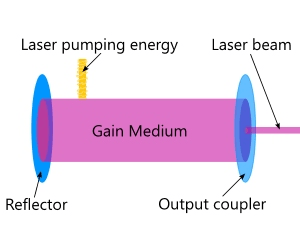
Image credit: Enlighten Your Mind
Diode lasers achieve amplification by pumping an electric current (or occasionally another light source) across a p-n junction, also known as a diode. P-n junctions are created by doping impurities onto a semiconductor material to form a region with p-type conductors (which carry current due to the absence of electrons in the material) and n-type ones (which carry current due to excess electrons). The depletion layer — the region between p- and n-type materials — takes on interesting electrical properties which make it useful in many different semiconductor applications.
In the case of diode lasers, special p-n junctions are used to introduce optical gain to the semiconductor, effectively establishing the semiconductor as the gain medium. The image below shows a deconstructed diode laser. Note the presence of the bonding wire (the medium for pumping electric current), the diode (gain medium), and the optical window (the optical resonator).

Image credit: Florida State University
Characteristics
Diode lasers are typically edge-emitting light sources, meaning that the beam is output from the edge of the semiconductor chip. Based on this fact, diode lasers have several desirable attributes:
-
The potential to be manufactured as a very small package.
-
Higher efficiency than conventional gas or dye lasers.
-
Low power and current requirements.
-
Fast operation and sensitivity to minute changes in input current.
-
Possibility for use over a broad optical spectrum (ultraviolet to far infrared).
-
Superior safety, with little risk of electric shock due to low power consumption.
While the above advantages make diode lasers suitable for many different applications, the devices also have inherent disadvantages as well. Diode lasers are typically suitable only for uses requiring relatively divergent beams with shorter coherent distances. Also, as electrical devices, they are prone to static interference and gradual loss of efficiency over time.
Applications
Diode lasers represent the vast majority of the laser market due to their small size, low cost of mass production, and wide range of applications. Common uses are listed below, with approximate wavelengths appended in parentheses.
-
Fiber optics (1000 - 1300 nm)
-
Gas sensing (1500 - 3300 nm)
-
Barcode readers (typically 650 nm or 950 nm)
-
Laser pointers (450 - 800 nm)
-
Optical disc readers - CD-ROM, DVD, CD players (650 - 800 nm)
-
Laser printing
-
Laser surgery (1000 nm)
Specifications
Module vs. Diode
When selecting diode lasers, it is important to understand the difference between a basic laser diode and a laser diode module.
A laser diode is a device identical to the image above: it is a self-contained laser device meant to be integrated into an existing electronic or optical system. A diode laser module, on the other hand, includes not only the diode itself but also complementary optics and electrical systems.

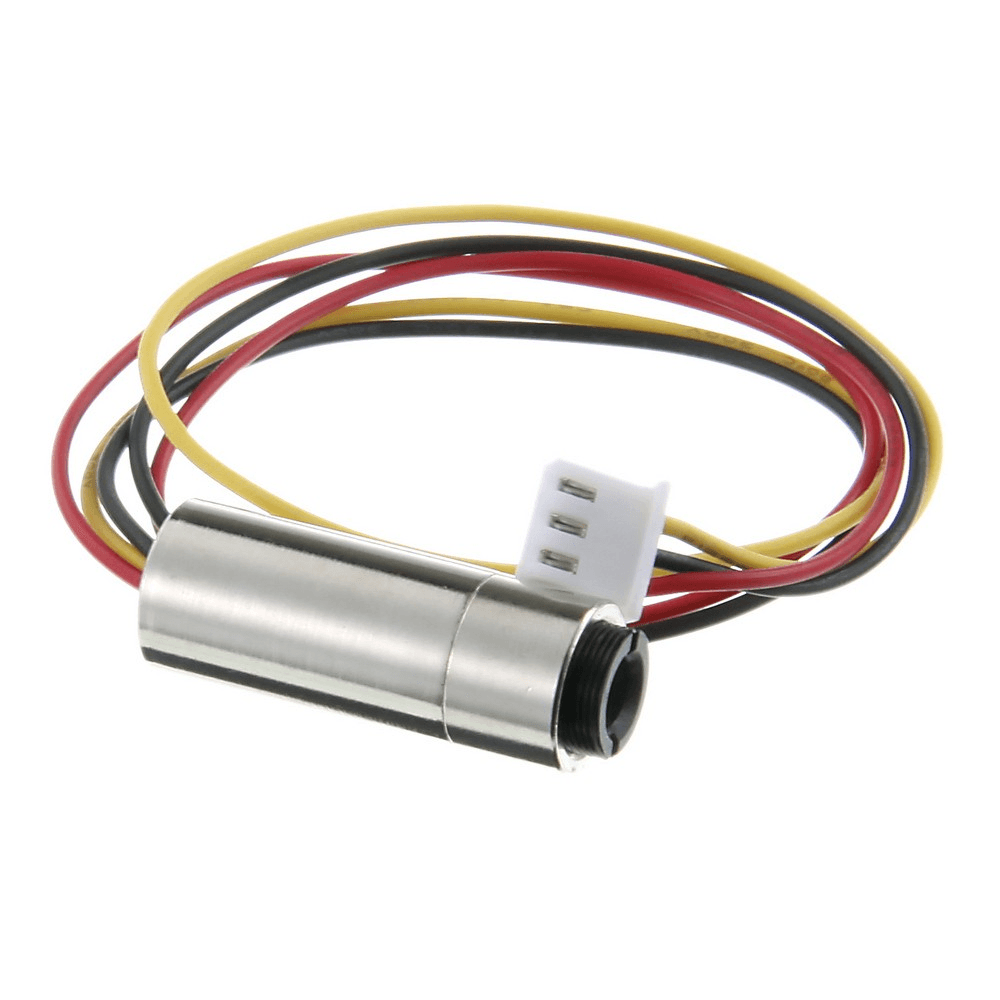
A packaged laser diode (left) and a laser diode module (not to scale).
Image credit: Intense Ltd. | Lasers World
Wavelength Range
Like all lasers, a diode laser's wavelength determines the color of the output beam and is itself determined by the characteristics of the laser's gain medium. Wavelength is specified by the manufacturer and may fall within several ranges:
-
The infrared spectrum describes wavelengths from 1 mm to 700 nm.
-
The visible spectrum includes wavelengths from 700 nm to 380 nm. This range can be subdivided into colors; for example, lasers which produce an orange beam emit radiation at a wavelength between 590 and 620 nm.
-
Ultraviolet radiation includes wavelengths from 380 nm to 10 nm.
Lasers may also be specified as tunable, meaning that they include a means to adjust the wavelength of their output beam.

The electromagnetic spectrum, showing the relative positions of the infrared, visible, and ultraviolet ranges.
Image credit: Science Learning
Standards
The manufacture, testing, and application of laser diodes may be governed by certain regional and international standards. Examples of these standards are listed below.
-
JIS C 5940 - General rules of laser diodes for fiber optic transmission
-
TIA-455-127 - Basic spectral characterization of laser diodes
-
ANSI 136.2 - Safe use of optical fiber communications systems utilizing laser diode and LED sources
References
Sam's Laser FAQ - Diode Lasers
- 532nm
- 4.9mw diode green laser
- 635nm Red LED
- f1 diode laser
- laser diode socket
- laser diode submount
- semikron b6u
- specifications of 1n60 diode
- 405nm laser diode system
- 450mw 405nm laser diode
- 532nm laser diode module
- fiber coupled laser diode 976nm
- fiber coupled laser diode module
- pulsed 650nm diode laser
- opto power diode lasers
- surgical diode lasers
- TTL modulation diode lasers