Electronic Instrument Handbook, Third Edition
Dave Richey
Agilent Technologies
Loveland, Colorado
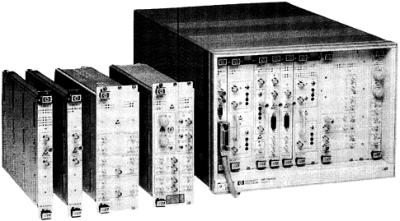
Modular instruments use a frame (Fig. 40.1), into which different types, or a varying number, of functional cards can be plugged. This is so that the instrument can accommodate a range of input/output channels or tailor its measurement capability according to the specific application being addressed.
The modular instruments described in this chapter support an industry standard. The modular instrument standards include:
VME standard
VXI standard
Personal computer plug-ins
CompactPCI standard.
PC plug-ins are not part of a formal standard. The ubiquity of the personal computer, however, has made the PC motherboard I/O bus a defacto standard for instruments.
Although all these standards are used for instrument systems, only VXI and a derivative of CompactPCI (called PXI) were developed expressly for instrumentation. For general-purpose instrumentation, VXI has the most products. PXI is emerging in the market, and it generally has the same features as VXI. More attention is given to VXI in this section.
Standards-based modular instruments can accept products from many different vendors, as well as user-defined and constructed modules.
Modular instruments generally use a computer user interface instead of displays and controls embedded in the instrument s frame or package. Because they do not have their own user interface, modular instruments are often called faceless instruments. By...