Electronic Instrument Handbook, Third Edition

5.10: Chemfet Transducers

5.10 Chemfet Transducers

The operation of the chemical field-effect transistor (ChemFET) transducer is similar to the operation of a standard metal-oxide-semiconductor field-effect transistor (MOSFET). ChemFETs are miniature transducers that are used for the measurement of the concentration of certain gases and for the determination of hydrogen ion concentrations (pH).

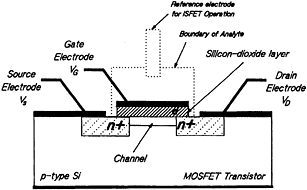
Figure 5.17 shows a cross section of a conventional MOSFET device.35 It consists of a source, a drain, and a channel that enables the flow of current I D from the source to the drain. An aluminum gate electrode on the oxide layer d above the channel modulates I D as a function of the gate voltage V G . The V D vs. I D characteristics of a MOSFET as a function of V G display a linear region,35 and for small values of V D and I D , the channel behaves as a resistor. The transduction mechanism in a MOSFET is basically to sense the charge on the gate electrode and then use that charge to modulate the flow of charges in the channel between the source and the drain.


Figure 5.17: Metal-oxide-semiconductor field-effect transistor (MOSFET) used as a ChemFET transducer. In ChemFET transducers the conventional aluminum gate electrode is not used and the region above the silicon dioxide layer is exposed to the gas or liquid to be analyzed. For gas analysis, metals like palladium and platinum are used as gate electrodes. For liquids, the SiO

UNLIMITED FREE
ACCESS
TO THE WORLD'S BEST IDEAS

SUBMIT
Already a GlobalSpec user? Log in.

This is embarrasing...

An error occurred while processing the form. Please try again in a few minutes.

Customize Your GlobalSpec Experience

Category: Metal-Oxide Semiconductor FET (MOSFET)
Finish!
Privacy Policy

This is embarrasing...

An error occurred while processing the form. Please try again in a few minutes.