Electronic Instrument Handbook, Third Edition
David R. Workman [*]
Consultant, Littleton, Colorado
This section follows today s concepts and practices in the use of measurement systems. It is based upon the Syst me International (SI), or International System of Units, and more specifically upon the meter-kilogram-second-ampere system (mkas) of relationships of units of electrical quantities.
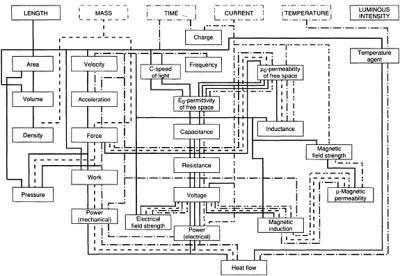
In the genealogy of measurement quantities we picture a lineage of derived quantities that are related to the base quantities. This is shown in Fig. 3.1. In this delineation the derived quantities are limited to those associated with the electrical measurement system, plus several others that are of general interest. About thirty such derived quantities are recognized today.
Although various physical quantities could be considered as basic in a measurement system, at least academically, the SI is based upon those of length, mass, time, electric current, temperature, and luminous intensity. The quantities of length come to be called mechanical quantities and units by common usage. Some systems, such as the centimeter-gram-second system (cgs) or the meter-kilogram-second system (mks) for electromagnetic quantities, recognize only three base units. Both these systems are coupled to the metric system of units. In the older cgs system (actually two, the electrostatic and the electromagnetic) the base units are the centimeter, gram, and second. In the mks system the base units are...