Electronic Instrument Handbook, Third Edition

J. Fleming Dias
Agilent Technologies
Palo Alto, California
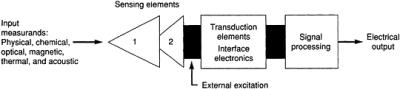
In general terms, the transduction process involves the transformation of one form of energy into another form. This process consists of sensing with specificity the input energy from the measurand by means of a sensing element and then transforming it into another form by a transduction element. The sensor-transduction element combination shown in Fig. 5.1 will henceforth be referred to as the transducer. Measurand relates to the quantity, property, or state that the transducer seeks to translate into an electrical output.
As an example, consider a walkie-talkie intercom set where the loud-speaker also functions as a microphone. At the input end, the loudspeaker functions as an acoustoelectric transducer and at the output end as an electroacoustic transducer. Moreover, in the reverse direction, the functions of the loudspeakers are interchanged, and for this reason we say that the loud-speaker is a bidirectional transducer and the transduction process is reversible.
Another example of reversible transduction is seen in piezoelectric materials; when an electric voltage is applied to the faces of a piezoelectric substrate, it produces a change in its physical dimensions; and conversely, when the material is physically deformed, an electric charge is generated on these faces. In this transducer, the sensing and transduction...