Electronic Instrument Handbook, Third Edition
5.7: Electromagnetic Transduce

5.7 Electromagnetic Transduce

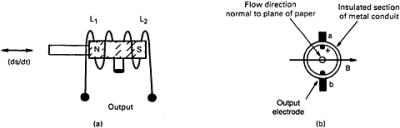
When a moving conductor of length l or a single-turn coil of the same length moves with a velocity ds/dt across and perpendicular to the lines of magnetic flux of density B, an emf is generated in the conductor (coil) which is given by Faraday s law as e= Bl ds/dt. Now l ds represents an area through which the flux lines cross during the time dt, and Bl ds is the corresponding differential flu d through that area. The emf generated corresponding to N turns is

(5.3)

Accordingly, the magnitude of the emf depends on the rate of crossing the lines of magnetic flux. This transduction mechanism is utilized in a velocity-measuring transducer. Figure 5.7a shows two coils L 1 and L 2, which are connected in phase opposition. The measurand is linked to the permanent magnet, which slides freely in the coils. The rate of movement of the magnet determines the velocity of the measurand. The output voltage is proportional to the velocity for all positions of the magnet. These transducers are known as linear velocity transducers (LVTs).19


Figure 5.7: Electromagnetic Transducers. (a) Linear velocity transducer (LVT). (b) Flow velocity transducer

Another application of this transduction mechanism is in sensing the flow velocity V of an electrically conducting fluid as shown in Fig. 5.7b . the flow is into the plane of the paper. The magnetic field...

UNLIMITED FREE
ACCESS
TO THE WORLD'S BEST IDEAS

SUBMIT
Already a GlobalSpec user? Log in.

This is embarrasing...

An error occurred while processing the form. Please try again in a few minutes.

Customize Your GlobalSpec Experience

Category: Electric Brakes
Finish!
Privacy Policy

This is embarrasing...

An error occurred while processing the form. Please try again in a few minutes.