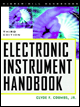
Electronic Instrument Handbook, Third Edition
Charles Kingsford-Smith
Agilent Technologies
Lake Stevens, Washington
This chapter deals with signals and, in particular, the production or generation of signals, rather than the analysis of them.
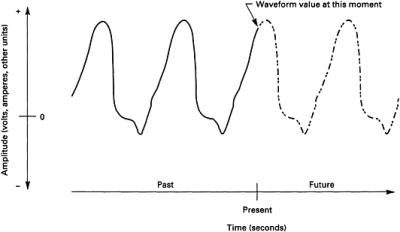
What is a signal and how is it characterized? The simplest useful definition is that a signal is an electrical voltage (or current) that varies with time. To characterize a signal, an intuitive yet accurate concept is to define the signal s waveform. A waveform is easy to visualize by imagining the picture a pen, moving up and down in proportion to the signal voltage, would draw on a strip of paper being steadily pulled at right angles to the pen s movement. Figure 7.1 shows a typical periodic waveform and its dimensions.
A signal source is an electronic instrument which generates a signal according to the user s commands respecting its waveform. Signal sources serve the frequent need in engineering and scientific work for energizing a circuit or system with a signal whose characteristics are known.
Most signals fall into one of two broad categories: periodic and nonperiodic. A periodic signal has a waveshape which is repetitive: the pen, after drawing one period of the signal waveform, is in the same vertical position where it began, and then it repeats exactly the same drawing. A sine wave (see below) is the best-known periodic signal. By contrast, a nonperiodic signal has a nonrepetitive waveform. The best-known...