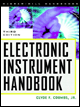
Electronic Instrument Handbook, Third Edition
Tim Tillson
Agilent Technologies
Loveland, Colorado
The development of digital technologies in instrumentation, along with the pervasive use of computers and networks, changed the way we think of and use both electronic instruments and measurements themselves. Major drivers, such as those listed, are having the effect of distributing the traditional notions of instrument and measurement.
The growth of networks along with the numbers and kinds of devices attached to them.
The doubling of computational power, roughly every 18 months ( Moore s Law ), affects both computers and the speed measurements can be made.
The pervasive use of Windows operating systems and applications on the desktop.
Consider a scenario where many inexpensive temperature sensors are publishing real-time data on a network. A small computer might be listening to all the reports, deciding which ones are of interest, and reducing the data by some level. This information could be passed on to a larger personal computer, where an engineer is writing a program that interacts with a software interface on a still larger computer to further analyze the data. The output of this program might go to a large enterprise database somewhere else on the network.
In this example, the instrument is smeared across the dimensions of time and space, in both hardware and software. Likewise, the measurement is a hierarchy of increasing data abstractions. A person at the sensor level and a person at the enterprise data level are likely to think of the measurement differently.
These changes have...