Electronic Instrument Handbook, Third Edition
Steve Warntjes
Agilent Technologies
Colorado Springs, Colorado
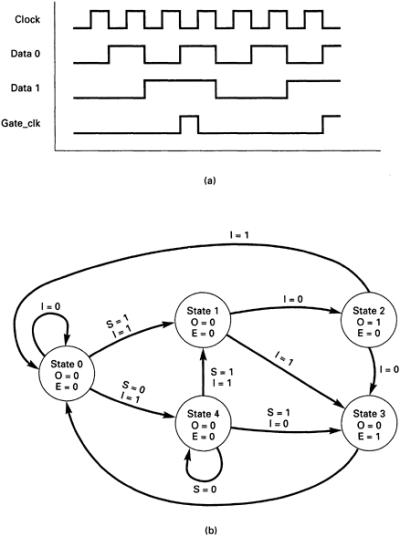
The advent of digital circuits dramatically changed the concerns of engineers and technicians working with electronic circuits. Ignoring for a moment digital signal quality or signal integrity, the issues switched from the world of bias points and frequency response to the world of logic ones, zeros, and logic states (see Fig. 29.1). This world has been called the data domain.
Using off-the-shelf components virtually guarantees correct values of voltage and current if clocks are kept to moderate speeds (less than 50 MHz) and fan-in/fan-out rules are observed. The objective for circuit verification and testing focuses on questions of proper function and timing. Although parametric considerations are simplified, the functional complexity and sheer number of circuit nodes is increased tremendously. Measurements to address these questions and to manage the increased complexity are the forte of the logic analyzer. Logic analyzers collect and display information in the format and language of digital circuits.
Microprocessors and microcontrollers are the most common logic-state machines. Software written in either high-level languages, such as C, or in the unique form of a processor s instruction set (assembly language) provide the direction for these state machines that...