Electronic Instrument Handbook, Third Edition

Resistive transducers have many and varied applications in the transduction of measurands such as displacements, mechanical strain, pressure, force and load, temperature, and fluid velocity into electrical outputs. The transduction mechanisms are based on the change in resistance brought about by the measurands.
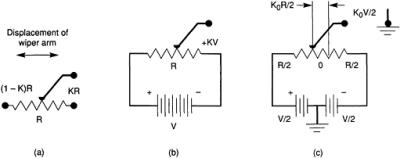
A potentiometric transducer is a mechanically driven variable resistor. It consists of a wire-wound fixed resistor and a wiper arm that slides over it and in so doing taps a different segment of the resistor, as shown diagrammatically in Fig. 5.8a and b, where K represents a fraction of the resistor that is tapped. The displacement to be measured is linked by a shaft to the wiper arm, and a measure of the displacement is the fractional resistance KR or the fractional voltage KV. This is the transduction mechanism.
The resolution that one can achieve with this transducer depends on the gage of the nickel alloy or platinum wire used. For extremely fine resolution, the wire is replaced by a metallized ceramic or a film resistor. If the resistance wire is wound on a doughnut-shaped tube, the wiper will measure angular displacements. The output...