Electronic Instrument Handbook, Third Edition
John J. Corcoran
Agilent Technologies
Palo Alto, California
Analog-to-digital converters, often referred to as A/D converters or simply ADCs, have played an increasingly important role in instrumentation in recent years. Once central to the function of only basic instruments like digital voltmeters, ADCs are now at the heart of more complex instruments like oscilloscopes and spectrum analyzers. In many cases, external instrument specifications are limited by the performance of the internal A/D converter.
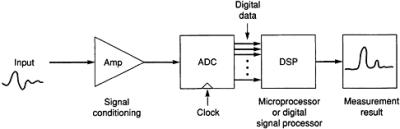
The increasing importance of ADCs to instruments has been driven by the development of high-performance integrated circuit (IC) technology. This has enabled higher-speed and higher-resolution ADCs to be designed, manufactured, and sold at reasonable cost. Equally important, advanced IC technology has led to the microprocessor and fast digital signal processing capability, which are essential in providing a low-cost transformation from the raw data generated by the ADC to the measurement results sought by the user (Fig. 6.1).
To understand modern instrument performance it is important to understand the basics of ADCs. This chapter first defines an analog-to-digital converter and describes typical ADC building blocks. The three most common ADC architectures are then described in some detail. The chapter concludes with a cliscussion of A/D converter specifications and testing techniques.
The basic function of an A/D converter is to convert an analog value (typically represented by a voltage) into...