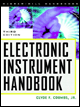
Electronic Instrument Handbook, Third Edition
James M. McGillivary
Agilent Technologies
Rockaway, New Jersey
The term instrument system can be used to describe a broad spectrum of systems, such as a voltmeter and a printer to many instruments and computers interlinked into an automated manufacturing environment. The basic reason that instruments are placed into systems is to achieve capabilities that the individual instruments do not have. If an instrument could do all the measurements that the user required, automated them, and compiled the data, there would be no need for a system. In this case, the system design and integration were performed by the instrument manufacturer. The likelihood of this occurring is very small because there are too many different types of measurements, and each device being tested uses its own particular subset of them.
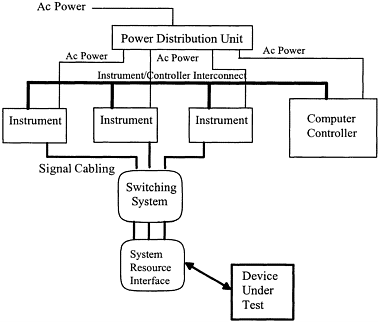
A typical block diagram is shown in Fig. 38.1. General descriptions of the major elements follow the block diagram.
Instruments are the devices used to take the actual measurements. These can be standard off the shelf instruments or custom instruments designed for a special purpose. A system designer has to specify which instruments are required in the system to make all of the correct measurements. The four main types of instruments are:
Measurement instruments, which measure the output of the DUT.
Stimulus instruments, which supply the required input signal to the DUT.
Switching instruments, which route the measurement...