5.11 Piezoelectric Wave-Propagation Transducers
Piezoelectricity derives its name from the Greek word piezein, to press. When a piezoelectric crystal is strained by an applied stress, an electric polarization is produced within the material which is proportional to the magnitude and sign of the strain this is the direct piezoelectric effect. The converse effect takes place when a polarizing electric field produces an elastic strain in the same material.
Typical materials used in transducers are crystalline quartz, lithium niobate, several compositions of ferroelectric ceramics, ferroelectric polymers,39 and evaporated or sputtered films of cadmium sulfide and zinc oxide. The ferroelectric ceramics commonly used are PZT4, PZT5A, PZT5H, and PZT7. The elastic, dielectric, and piezoelectric properties of these materials can be found in Refs. 38, 39, and 40. In addition, using these PZT materials, new and more efficient piezocomposites have been developed.45
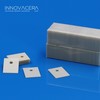
Ferroelectric ceramics are not piezoelectric when they are manufactured and therefore have to be poled. Poling is done by applying a high dc voltage to the electrode faces normal to the thickness direction, while maintaining the ceramic in a high-temperature environment.38 Ceramic transducers are generally rectangular, circular with parallel faces, or have a spherical curvature.
The conversion efficiency of a piezoelectric transducer is defined by the electromechanical coupling factor K.
for the direct piezoelectric effect, and
for the converse piezoelectric effect.
K 2 is always less than unity. Typical values of K are 0.1 for quartz, 0.5 to 0.7 for ferroelectric ceramics, and 0.2 to 0.3 for copolymer materials like...


 TABLE OF CONTENTS