Electronic Instrument Handbook, Third Edition
Calvin Erickson
Agilent Technologies
Loveland, Colorado
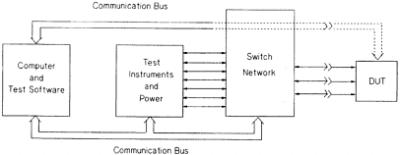
Switching is a frequently overlooked but vital component of automated test systems. Test systems typically consist of a computer, test software, instrument hardware, switching, and a communication bus. Figure 39.1 shows a simple system block diagram. Switching provides the interface between the test system and the device under test (DUT). The switching block routes the test signals, power, and often the control lines to and from the DUT.
Switching provides test system flexibility and expandability. Signals may be redirected automatically to different DUT points or to different instruments. This allows a system to be reconfigured regularly on a high-mix production line or to be expanded in the future for the next-generation DUT.
Switching allows the set of expensive instrumentation to be minimized. This is especially important as density increases. One voltmeter, for example, can be used to measure many different points sequentially on the DUT. It is also possible to make many different measurements on the same set of points.
Switching simplifies the task of system calibration, self-test, and diagnostics. Source instrumentation (such as a pulse generator) can be routed back to sensor instrumentation (such as a counter). This arrangement may be used to check the operation of the instruments and the switches, as well as to monitor the effects of cabling and interconnect.
Switching equipment degrades signals by introducing path resistance, thermal offsets, inductance, and capacitance (both signal-to-signal...