5.5 Capacitive Transducers
The change in capacitance in response to a measurand has many applications in physical transducers. Displacements, velocity, acceleration, force, pressure, vacuum, flow, fluid level, audio sound field, and relative humidity can be measured using capacitive transducers.
The capacitance between parallel conducting plates with a dielectric material between them is given by
| (5.1) | 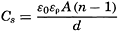
|
where <i class="emphasis"><span class="unicode">?</span></i><sub0</sub>=permittivity of free space=8.854 10<sup 12</sup> farad/m<i class="emphasis"> <span class="unicode">?</span></i><sub<i class="emphasis"><span class="unicode">?</span></i></sub>=relative permittivity or dielectric constant of the material, thevalue usually tabulated in handbooks (<i class="emphasis"><span class="unicode">?</span></i><sub<i class="emphasis"><span class="unicode">?</span></i></sub>=1 for air)<i class="emphasis"> A</i>=area that is common to both plates (overlap area, m<sup2</sup>)<i class="emphasis"> d</i>=separation between plates, m<i class="emphasis"> n</i>=number of plates<i class="emphasis"> C</i><sub<i class="emphasis">s</i></sub>=capacitance, farads
Equation 5.1 indicates that the capacitance varies linearly with the area A and the dielectric constant of the material, but it varies inversely with the separation between plates. Any changes in the above-mentioned parameters caused by a measurand, and taken one at a time, provide practical transduction mechanisms.
Figure 5.2 shows some of the configurations where the changes in C s are used to measure physical measurands. The first two lend themselves to the measurement of displacement, force, flow, vacuum, and pressure, and the third configuration could be used to measure...


 TABLE OF CONTENTS