
Boron Carbide Industrial Ceramic Materials
Last Updated: April 1, 2025
Description
Boron Carbide is an industrial ceramic material known for its extreme hardness and wear resistance. It is often referred to as "black diamond" due to its hardness, which is nearly comparable to that of diamond. This material is characterized by its stability against ionizing radiation, resistance to chemical reactions, and excellent neutron shielding properties. Boron Carbide is a p-type semiconductor and is used in various forms, including powders and dense shapes, for different industrial applications.
Working Principle
Boron Carbide works by leveraging its unique crystal structure, which consists of C-B-C chains and B12 icosahedra. This structure contributes to its extreme hardness and stability. The material's hardness allows it to resist wear and abrasion, making it suitable for processing other hard substances. Its semiconducting properties are dominated by hopping-type transport, which is typical for p-type semiconductors. Additionally, Boron Carbide's ability to form a protective B2O3 layer at high temperatures enhances its durability in harsh environments.
Applications
Boron Carbide is used in a variety of applications due to its unique properties. It serves as an abrasive and lapping agent, particularly effective in processing ultra-hard materials. In the manufacturing of ceramic blasting nozzles, Boron Carbide's wear resistance ensures durability even with hard abrasive agents like corundum and silicon carbide. It is also utilized in ballistic protection, offering comparable protection to armored steel and aluminum oxide but at a significantly lower weight. In nuclear reactors, Boron Carbide acts as a neutron absorber, with the 10B isotope capturing thermal neutrons generated by fission reactions.
Advantages over other Industrial Ceramic Materials
Boron Carbide offers several advantages over other industrial ceramics. Its extreme hardness surpasses that of alumina and silicon carbide, making it highly effective in wear-resistant applications. The material's low specific gravity makes it ideal for lightweight armor, providing superior ballistic protection compared to heavier alternatives. Additionally, its ability to form a protective oxide layer at high temperatures enhances its performance in high-temperature environments.
Limitations
One limitation of Boron Carbide is its susceptibility to oxidation at temperatures above 600°C, which can soften its surface. This makes it unsuitable for dry grinding at high temperatures in abrasive applications. Additionally, the production of dense Boron Carbide shapes requires high temperatures and pressures, which can complicate manufacturing processes.
Considerations
When considering Boron Carbide for industrial applications, several factors should be taken into account. The initial costs can be high due to the complex manufacturing processes required to produce dense shapes. However, its durability and wear resistance can lead to lower operating expenses over time. Maintenance and replacement costs may also be reduced due to its long-lasting performance in abrasive and high-stress environments. The material's accuracy in applications such as neutron absorption is critical, and its performance should be evaluated based on specific application requirements.

from San Jose Delta Associates, Inc.
"PAD" (Pressure Assisted Densification) Boron Carbide is characterized by outstanding hardness, low specific gravity, excellent corrosion resistance and a high neutron absorbing cross-section. This material is suitable for light weight armor, nuclear and wear applications. [See More]
- Material Type: Carbide Material; Boron Carbide; Silicon Carbide
- Density: 2.48
- Shape / Form: Custom Shape
- MOR / Flexural Strength: 53083

from Saint-Gobain Performance Ceramics & Refractories
Saint-Gobain offers a choice of ceramic materials that can help reduce downtime in demanding nozzle applications with its Hexoloy® SiC and Norbide® materials.Hexoloy® SiC is the most popular alternative in the world to tungsten carbide. It provides long life (50% over WC) due to excellent wear and... [See More]
- Material Type: Carbide Material; Boron Carbide; Silicon Carbide
- Shape / Form: Spout

from CoorsTek
CoorsTek manufactures lightweight, superior ballistic performance ceramic components for armor integration. Each product is made of next-generation materials, shapes, and sizes for use in body, ground vehicle, aircraft, and marine applications to protect the soldiers of today and tomorrow. CoorsTek... [See More]
- Material Type: Carbide Material; Boron Carbide
- Thermal Conductivity: 50
- Composition: Reaction-Bonded Boron Carbide
- Density: 2.65
from Xiamen Wintrustek Advanced Materials Co., Ltd.
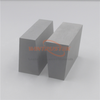
Boron Carbide (B4C), popularly known as black diamond, ranks third in hardness after diamond and cubic boron nitride. Because of its appealing combination of qualities, it is a good material for many high-performance applications. Its high hardness makes it an excellent abrasive powder for metal and... [See More]
- Material Type: Boron Carbide; SpecialtyMaterial
- Density: 2.5
- Shape / Form: Block

from Zhuhai Cersol Technology Co., Ltd.
Molecular formula: B4C Mohs hardness: 9.36 Density: 2.52g/cm ³. Melting point: 2450 °C Appearance: gray black powder. One of the hardest materials. It has become an ideal material for many industries because of its acid-base resistance, high temperature resistance. Main uses and... [See More]
- Material Type: Carbide Material; Boron Carbide

from Advanced Abrasives Corp.
Boron Carbide Powder. Boron carbide (B4C) with a Mohs hardness of 9.5 is second only to cubic boron nitride (cBN) and so makes an excellent lower cost alternative abrasive to cBN and diamond. Also, boron carbide is excellent for absorbing neutron radiation without forming long lived radionuclides... [See More]
- Material Type: Carbide Material; Boron Carbide
- Applications: Abrasive Applications
- Shape / Form: Powder, Grain or Grog

from 3M Advanced Materials Division
Sandblasting. Abrasive lapping. Machining ultra-hard metals, ceramics and synthetic gemstones. To withstand conditions in these demanding applications, it takes a material with extreme abrasion resistance – like 3M ™ Boron Carbide. Sometimes called “black diamond," boron carbide is... [See More]
- Material Type: Carbide Material; Boron Carbide
- Applications: Finishing, Grinding
- Shape / Form: Spout; Powder, Grain or Grog; Grannular Fill

from CoorsTek
CoorsTek provides some of the lightest armor components by developing specialty materials and processes for superior ballistic performance with minimal weight. Our lightweight technical ceramic tiles employ tight-tolerance manufacturing standards, high-purity formulations, and controlled... [See More]
- Material Type: Alumina; Carbide Material; Boron Carbide; Silicon Carbide
- Applications: Armor / Ballistic Protection
from Xiamen Wintrustek Advanced Materials Co., Ltd.
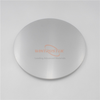
Boron Carbide (B4C) Ceramic is often used in nuclear applications such as shielding and other protective applications due to its ability to absorb neutrons. WINTRUSTEK offers Nuclear Grade Boron Carbide with a High B10 content formulated for use in nuclear applications. Typical Features. Low... [See More]
- Material Type: Boron Carbide; SpecialtyMaterial
- Density: 2.5