
Sapphire Industrial Ceramic Materials
Last Updated: April 1, 2025
Description
Sapphire industrial ceramic materials are known for their exceptional hardness and wear resistance. These materials are utilized in various forms, such as substrates, jewel bearings, and watch crystals, due to their durability and optical clarity. Sapphire ceramics are single-crystal materials, which means they do not contain any foreign materials, contributing to their purity and performance .
Working Principle
Sapphire ceramics work by leveraging their unique crystalline structure, which provides high hardness and wear resistance. This makes them particularly useful in environments where durability and longevity are critical. The material's optical transparency and ability to transmit infrared light even at high temperatures further enhance its utility in specialized applications. Sapphire's chemical inertness and thermal stability also contribute to its effectiveness in harsh conditions .
Applications
Sapphire materials are used in a wide range of applications due to their exceptional properties. Specific examples include optical windows, laser optics, and lenses, where their optical clarity is crucial. They are also used in high-temperature or high-pressure equipment as fixtures, and in semiconductor applications as substrates for high-speed integrated circuits. Additionally, sapphire is employed in the production of jewel bearings, valve balls, and wear parts due to its hardness and wear resistance .
Advantages over other Industrial Ceramic Materials
Sapphire ceramics offer several advantages over other industrial ceramic materials. They are harder and stronger in compression than most metals, providing superior durability. Sapphire can be polished to an optically clear finish, which is less than 1 microinch, making it ideal for applications requiring high precision and clarity. Its ability to transmit infrared light and resist scratches makes it particularly advantageous in optical and abrasive environments .
Limitations
One limitation of sapphire ceramics is their higher cost compared to other materials. This can be a significant factor in applications where cost is a primary concern. Additionally, the machining of sapphire requires specialized equipment and techniques, such as diamond grinding, due to its hardness, which can increase production complexity and cost .
Considerations
When considering the use of sapphire ceramics, it is important to evaluate the initial costs and operating expenses, as they can be higher than those of other materials. However, the durability and reduced maintenance requirements of sapphire can offset these costs over time. The material's accuracy and precision in applications are significant benefits, but the need for specialized machining can impact replacement and maintenance costs. Therefore, careful assessment of the application's requirements and long-term benefits is essential when choosing sapphire ceramics .
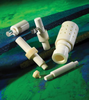
from Insaco, Inc.
These pieces represent a large part of our business we developed by learning how to achieve the very tight diameters, and cylindricities needed for these applications. With piston/sleeve clearances down to .00004 ″, pumping is possible without use of flexible seals. Applications include... [See More]
- Material Type: Alumina; Sapphire
- Shape / Form: Custom Shape
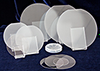
from Monocrystal, Inc.
Due to its dielectric and crystallographic properties, sapphire is an outstanding material for producing various wafers for electronic applications. Sapphire is the basic material in LED production, as its crystal lattice allows the growth of an epitaxial layer of gallium nitride (GaN) with fine... [See More]
- Material Type: Sapphire
- Width / Diameter: 2 to 10
- Shape / Form: WaferCarrier
- Thickness: 0.0059 to 0.0394

from San Jose Delta Associates, Inc.
Sapphire is diamond ground using the same general processes as any dense alumina oxide material. While it tends to chip easier than alumina, simple grinding procedure and technic can accommodate this characteristic. Due to the relatively high cost of sapphire care should be taken to remove a minimal... [See More]
- Material Type: Sapphire
- Max Use Temperature: 2000
- Shape / Form: Custom Shape
- Thermal Conductivity: 10 to 40

from Stettler Sapphire AG
Due to its unique combination of outstanding physical properties, sapphire is perfectly suitable for a multitude of applications. Its optical characteristics combined with high temperature resistance help explain why sapphire is indispensable in laser technologies. It is equally valuable as a... [See More]
- Material Type: Sapphire; SpecialtyMaterial
- Thermal Conductivity: 41.84
- Max Use Temperature: 2200
- CTE: 5.4 to 6.2
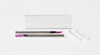
from Swiss Jewel Company
Sapphire Blades are an excellent choice for various applications. Sapphire's hardness and excellent surface finish provide a superior surface for precision work. Sapphire blades are commonly used on fiber optics for cutting and scribing. Sapphire is also a non-thrombogenic material for use in... [See More]
- Material Type: Sapphire
- Shape / Form: Custom Shape
- Composition: Al2O3
- Length: 0.5800 to 0.7350

from Stettler Sapphire AG
Watch crystals made of sapphire are known for their scratch resistance, nonporous and shiny polished surface as well as perfect transparency. It is truly a material destined to appeal to generations to come. Stettler Sapphire offers the liberty of design, from classic or complex crystals to toric... [See More]
- Material Type: Sapphire; SpecialtyMaterial
- Thermal Conductivity: 41.84
- Max Use Temperature: 2200
- CTE: 5.4 to 6.2

from Swiss Jewel Company
Sapphire Rods are used in a wide range of applications. A sapphire rod can be made with all surfaces polished for optical and wear applications or with all surfaces fine grind (un-polished) to serve as an insulator. Sapphire Rods are available in a range of outer diameter and lengths. OD's as small... [See More]
- Material Type: Sapphire
- Shape / Form: BarStock
- Composition: Al2O3
- Length: 0.0950 to 2973
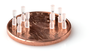
from Swiss Jewel Company
A Sapphire Saddle Pin is a rod with a concave groove in the middle. This area provides a wear surface which can capture the element and keep it centralized. Saddle pins are valuable as wiring guides. Typical Saddle Pin Applications: Wire Guides [See More]
- Material Type: Sapphire
- Shape / Form: Custom Shape
- Composition: Al2O3
- Length: 0.1770 to 0.1850