
Power Diodes Information
Last revised: October 5, 2024
Reviewed by: Scott Orlosky consulting engineer
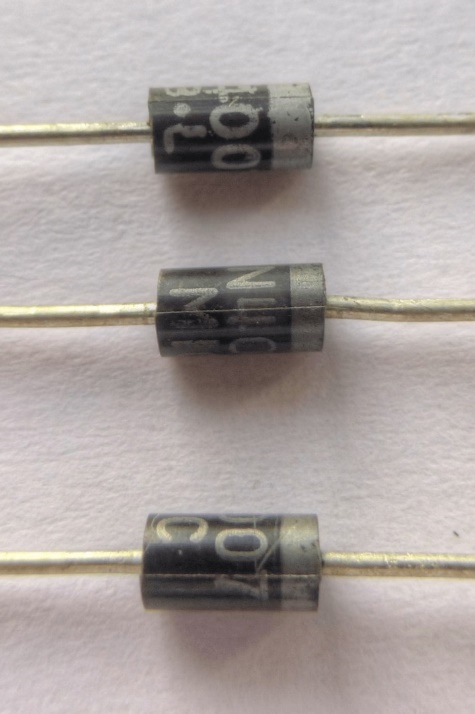 Power diodes are used mainly in high-power applications. They are built with large P-N junctions in order to pass large amounts of current and dissipate large amounts of heat. Power diodes can also withstand high voltage diodes when operated in reverse bias.
Types of Power Diodes
There are many different types of power diodes. Examples include:
- high current diodes
- high voltage diodes
- PIN power diodes
- RF power diodes
- switching power diodes
- rectifier power diodes
Basic power diodes consist of a diode built into a chip. Power diode arrays are composed of multiple, discrete, and usually unconnected devices on a single silicon chip. PIN count and number of embedded diodes vary by integrated circuit (IC) package type. Power diodes that are sold in Europe must comply with the Restriction of Hazardous Substances (RoHS) directive from the European Union (EU).
Specifications
Performance specifications for power diodes include
- junction operating temperature
- reverse recovery time
- repetitive peak reverse voltage or maximum reverse voltage
- peak forward surge current
- reverse current
- forward voltage
Junction operating temperature is the range of temperatures over which power diodes are designed to operate. Reverse recovery time is the time taken for the reverse current to reach a specified level when the reverse voltage is applied while the power diode is conducting in the forward direction.
Repetitive peak reverse voltage or maximum reverse voltage is the maximum allowable instantaneous value of reverse voltage repeatedly applicable. Peak forward surge current is the maximum allowable surge value of forward current without repetition. Forward voltage is the specified forward current input for power diodes.
Some suppliers provide additional specifications for a high current diode, high voltage diode, power diode array, PN power diode, PN power diode array, high power diode, RF power diode, PIN power diode, switching power diode, or rectifier power diode.
Features
Power diodes use many different IC package types. Examples include:
- diode outline (DO)
- small outline diode (SOD)
- transistor outline (TO)
- small outline transistor (SOT)
- discrete package (DPAK)
- metal electrode leadless face (MELF)
DO-4, DO-5, DO-8, DO-9, DO-15, DO-27, DO-34, DO-35, DO-41, and DO-201 are diode outline (DO) packages. The most common packages in the DO family, used for power diodes are the Do-41 or DO-204-AL
SOD-80, SOD-106, SOD-123, SOD-323, and SOD-523 are small outline diode (SOD) packages. Within the SOD family, SOD66 is the most popular form for power diodes.
TO-3, TO-66, TO-92, TO-202, TO-220, TO-237, and TO-247 are transistor outline (TO) packages.
SOT23, SOT26, SOT89, SOT143, SOT223, SOT323, SOT343, SOT346, SOT353, SOT363, SOT416, SOT457, and SOT523 are small outline transistor (SOT) packages.
MELF packages (Metal Electrode Leadless Face) for power diodes include QuadroMELF, MicroMELF, and MiniMELF.
D2PAK is a large surface-mounted package that includes a heat sink. SC-59, SC-74, and SC-76 are plastic, surface-mounted packages with three leads.
Power Diodes FAQs
What is the forward voltage drop of a typical power diode?
The forward voltage drop (VF) of a typical power diode, formed from a silicon PN junction, is around 1 V.
What is the significance of the peak forward surge current?
The peak forward surge current is the maximum current a diode can handle in a short burst without damage. This is crucial for applications where the diode might experience sudden high current surges.
What is the leakage current in power diodes?
Leakage current is the small current that flows through the diode when it is reverse biased. In an ideal diode, this would be zero, but practical diodes do exhibit a small leakage current
How do users select the right power diode for a specific application?
Selecting the right power diode for a specific application involves considering several key factors and specifications. Importantly, users should determine the application requirements:
- Rectification: If the application involves converting AC to DC, general-purpose diodes or fast recovery diodes might be suitable.
- Switching speed: High-speed switching applications, fast recovery diodes (FRD) or Schottky barrier diodes (SBD) are preferred due to their low reverse recovery time.
- Voltage and current ratings: Identify the maximum voltage and current the diode will need to handle.
What is the role of power diodes in rectification?
Power diodes are commonly used in rectification circuits to convert alternating current (AC) to direct current (DC). They are used in bridge rectifiers and other rectification configurations to ensure unidirectional current flow
What is the importance of reverse recovery time in power diodes?
The importance of reverse recovery time in power diodes can be understood through several key points.
In power electronics, the efficiency and performance of circuits such as AC-DC converters and inverters are highly dependent on the switching characteristics of the diodes used. A shorter reverse recovery time means the diode can switch off faster, reducing the time it spends in the transition state where it can dissipate power as heat. This leads to higher efficiency and lower thermal stress on the diode and surrounding components.
In high-frequency applications, such as DC-DC converters and certain types of inverters, the reverse recovery time becomes even more critical. A long reverse recovery time can cause significant power losses and generate unwanted noise, which can interfere with the operation of other components in the circuit.
Modern power electronic systems often use fast-switching devices like MOSFETs and IGBTs. To fully leverage the speed of these devices, the diodes used in the circuit must also have fast switching characteristics, including a short reverse recovery time. This ensures that the overall system can operate efficiently at high speeds.
In summary, the reverse recovery time of power diodes is a critical parameter that affects the efficiency, thermal performance, and overall reliability of power electronic systems, especially in high-speed and high-frequency applications.
What is the difference between a power diode and a signal diode?
Power diodes are designed to handle high current and high voltage, making them suitable for power electronics applications. Signal diodes, on the other hand, are used in low current and low voltage applications, such as signal processing and small-signal rectification.
What are the common failure modes of power diodes?
Common failure modes include thermal runaway, where excessive heat causes the diode to fail, and electrical overstress, where the diode is subjected to voltages or currents beyond its rated limits. In short, large reverse voltage leads to a shorted diode while overcurrent makes it fail open. Other failure modes can include mechanical damage and degradation due to environmental factors.
Power Diodes Media Gallery
References
Engineering360—Diodes Information
Engineering360—General Purpose Diodes Information
Engineering360—PIN Diodes Information
GlobalSpec—Power Electronics Handbook: Devices, Circuits and Applications, Second Edition
Image credit:
Nevit / CC BY-SA 3.0