Switch-Mode Power Converters: Design and Analysis

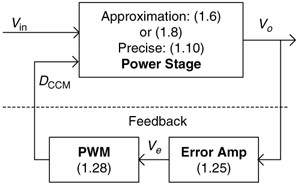
By this time, we basically have developed all the essential blocks for step-down power converters in CCM operation. We are ready to close the loop, which can be represented in block diagram form (Figure 1.10).
The block diagram is intentionally partitioned (dashed line) into two parts the feedback path and the power stage (plant, in control system terminology). Inside each block, the relevant equation governing the block function is given in parentheses. Equations (1.25) and (1.28) can be combined to give the open-loop duty cycle in terms of circuit components and open-loop output:
| (1.29) | |
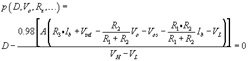
In theory, (1.29) can be further combined with (1.10) to yield the closed-loop output. But anyone attempting to do so soon realizes that it is a mission impossible, for (1.10) contains a D 2 term and squaring (1.29) is not a simple matter. Furthermore, even after plugging in the D 2 and D terms, (1.10) does not give the closed-loop output explicitly, because V o appears on both sides of the equation. One can use the approximation (1.8) instead but at the expense of accuracy. Do we have a way out? Yes, we can handle the situation using an implicit function. We first define two implicit functions from (1.29) and (1.10):
| (1.30) | |
| (1.31) | |
Given the two functions, and using the Jacobian determinant, the output sensitivity against all circuit components and variables can be easily obtained. For instance, the load...