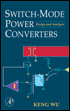
Switch-Mode Power Converters: Design and Analysis
Chapter 5: Current-Fed Push-Pull Converters

Overview

All buck-derived converters presented so far share one more common trait, the input line current pulsates if no additional input filter is incorporated. Coupled with the action of PWM, the pulsating current, equivalent to a high di/ dt, can create real problems, for instance, conducted emission generated by AC current rushing back and forth along the input wire/connection. The problem can be mitigated with the addition of an input filter including a choke (inductor). Well, if that is all it takes, why don't we just move the output filter inductor to the input side? This is the origin of current-fed (current-driven) converters in contrast to the voltage-fed (voltage-driven) converters given in Chapters 1 4.

In Figure 5.1, we show four current-fed converters. But we focus our attention on only 5.1(a).


Figure 5.1: Current-fed converters

Again, as in the case of voltage-fed push-pull converters, the clock frequency runs at twice the frequency both switches are subjected to. Then, because of the selection of the serial input inductor and permissible duty cycle range, all four topologies have four operating modes. Based on the switch frequency (one-half the clock frequency), switch duty cycle, D, defined as the ratio of switch on-time to the switch period T s( = 2 T osc) can be larger or smaller than 50%. Operations with a larger than 50% steady-state duty cycle are considered in an overlapping mode, whereas those in a smaller than 50% cycle are in a nonoverlapping mode. In addition,...

UNLIMITED FREE
ACCESS
TO THE WORLD'S BEST IDEAS

SUBMIT
Already a GlobalSpec user? Log in.

This is embarrasing...

An error occurred while processing the form. Please try again in a few minutes.

Customize Your GlobalSpec Experience

Category: Switching Power Supplies
Finish!
Privacy Policy

This is embarrasing...

An error occurred while processing the form. Please try again in a few minutes.