Switch-Mode Power Converters: Design and Analysis

Chapter 6: Isolated Flyback Converters

Overview

For power levels less than a few hundred watts, a flyback converter is a less-expensive choice due to its simplicity in hardware. Figure 6.1 illustrates a typical converter with the most representative features. Again, like the forward converter and depending on the loading and design considerations, the converter's main energy storage inductor may operate in two modes: DCM and CCM. As for the control technique, two approaches, voltage-mode control and current-mode control, are applicable. Wu [2] treated the subject in DCM using the voltage-mode and the peak current-mode controls. We do not duplicate those efforts but provide a refinement. We focus our coverage in the determination of critical inductance, the AC small-signal studies for DCM with peak-current mode, the DC studies for CCM with both voltage-mode and current-mode, the steady-state time-domain output, and the like.


Figure 6.1: Flyback converter with voltage-mode control

6.1 DCM Duty-Cycle Determination, Another Approach

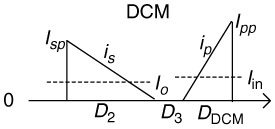
In Wu [2], the DCM duty cycle was determined based on the concept of total energy transfer. The book gives no information regarding the duration of the conducting and nonconducting flyback phases, identified as D 2 and D 3 in Figure 6.2, in which the relevant currents of a flyback converter operating in DCM are given. We fill the gap here.


Figure 6.2: Currents for a flyback converter in DCM

Based on simple geometry, the DC load current, I o, can be derived by

(6.1)

where L p is the primary inductance and f s is...

UNLIMITED FREE
ACCESS
TO THE WORLD'S BEST IDEAS

SUBMIT
Already a GlobalSpec user? Log in.

This is embarrasing...

An error occurred while processing the form. Please try again in a few minutes.

Customize Your GlobalSpec Experience

Category: Switching Power Supplies
Finish!
Privacy Policy

This is embarrasing...

An error occurred while processing the form. Please try again in a few minutes.