Overview
Nowadays, laptop and desktop personal computers (PC) operate at 1-2 GHz. Not long ago, computer clocks running at 700 MHz were considered super. Clearly, it is safe to bet that the PC operating speed (clock rate) will keep going up with no limit in sight. After all, in theory, the frequency spectrum is unlimited, if infinite energy is available and controllable instantaneously. Given finite energy, what can be done to elevate the electronic clock speed?
First, let us look at the prevailing form of the electronic clock: a rectangular, cyclically varying waveform with two distinctive voltages: one low, V L, the other high, V H (Figure 15.1). We can see from the figure that two quantities, the voltage swing ? v and the time span ? t, play the ultimate role in defining clock speed.
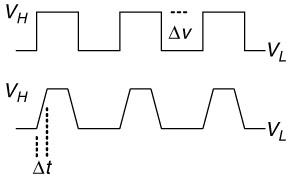 Figure 15.1: A clock signal
 At this juncture, we examine the reason why slanted edges, either up or down, are recruited for depicting the clock waveform instead of the ideal straight edges.
It is understood that every circuit node has some capacitance in reference to the power return, attributed either to the capacitor as designed or device junctions and stray parasitics. The output node of a clock source must swing across a specific threshold voltage to signify a state (logic) change. It is also understood that the voltage swing across a capacitor is the result of current shuffling in and out within a given time. The explanation, of course,...

 TABLE OF CONTENTS