Switch-Mode Power Converters: Design and Analysis
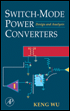
1.9: Current-Mode Control

1.9 Current-Mode Control

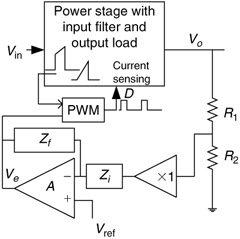
By nature, signals in current forms have advantages over those in voltage form, since voltage is an accumulation of electron flux and, therefore, slow in time as far as control mechanism is concerned. In the early 1980s, this understanding spawned a new tide in switch-mode power supply design, namely, the current-mode control. In this control mode, the averaged or peak current of magnetic origin is employed in the feedback loop of switch-mode power converters. However, by adding a current loop, the conventional concept of loop gain is blurred, since multiple loops exist and make it difficult to identify the main loop. The current-mode control techniques, in addition to introducing difficulties in loop identification, also create new territories for analysis. In this and following sections, we give this superior technique an in-depth study. We again cover both CCM and DCM operations using the peak current. The average-current current-mode control is set aside and covered in a separate chapter because of its mathematical complexity. But, let us first look at the general feature of a current-mode control scheme, Figure 1.18.


Figure 1.18: Peak-current current-mode control scheme

Evidently, the sole and key difference between Figures 1.7 and 1.18 is the way the reference ramp is generated. In the case of voltage-mode control, the ramp is external from the viewpoint of the power plant, whereas for current-mode control, it is internal. However, the superficial view alone does not unveil the superior nature of peak current-mode control. We definitely need to probe...

UNLIMITED FREE
ACCESS
TO THE WORLD'S BEST IDEAS

SUBMIT
Already a GlobalSpec user? Log in.

This is embarrasing...

An error occurred while processing the form. Please try again in a few minutes.

Customize Your GlobalSpec Experience

Category: Stepper Motor Drives
Finish!
Privacy Policy

This is embarrasing...

An error occurred while processing the form. Please try again in a few minutes.