Switch-Mode Power Converters: Design and Analysis

We shall depart from the presentation flow that has been the hallmark for the past six. Since current-mode control enjoys obvious advantages over voltage-mode control, we can omit the latter without disrupting the key aspects of the chapter. Because of that, this will be a short chapter. Nevertheless, we cover duty-cycle determination, critical inductance, and the steady state under closed loop, loop gain, and the like. All analyses focus on a single schematic, Figure 7.1, which is derived from Figure 6.10 by replacing the power stage with the nonisolated boost stage.
Figure 7.1 also shows major current waveforms for DCM and CCM operations. Given that, the procedure for determining the duty cycle for both cases is basically the same as that for the flyback converters. The case for CCM was covered in Wu [2]. We consider only DCM in this section.
We start with the requirement of volt-second, flux balance across the boost inductor L:
| (7.1) | |
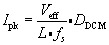
The switch peak current is
| (7.2) | |
The input line has a DC current
| (7.3) | |
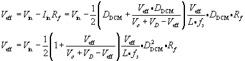
Considering the input losses R f, the effective input is
| (7.4) | |
The DC load current is given as
| (7.5) | |
The open-loop DCM duty cycle is embedded in (7.4) and (7.5).
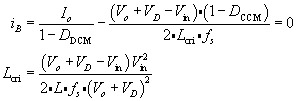
From the CCM current waveform, we again understand that the critical inductance can be decided by the boundary condition i B = 0:
| (7.6) | |
Based on the current...