Switch-Mode Power Converters: Design and Analysis

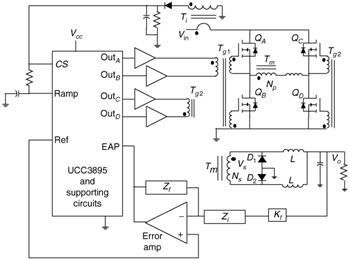
Basic forward converters are covered in the previous chapters. All those converters share a common trait: The duty cycle of the main switches varies significantly depending on the input voltage level and the load demand. Because of that, the Fourier harmonic contents of switching waveforms also change wildly and produce an undesirable electromagnetic interference environment and generate more local heat dissipation. The phase-shifted full-bridge converter shown in Figure 4.1 solves a major part of the problem by limiting the duty cycle to nearly a constant 50 for the left leg switches, Q A and Q B, while providing PWM by phase shifting the right leg switches, Q C and Q D, also in a near 50 duty cycle. In other words, all switches are not pulsewidth-modulated. Instead, the transformer winding and core volt-second are pulsewidth-modulated. Readers are referred to Texas Instrument's design considerations [4] for complete circuits.
Since the converter is still a buck converter in almost all aspects, we do not duplicate previous efforts in analyzing the circuit. Instead, we focus on the unique feature given for the first time in the circuit. As mentioned in the figure caption, a current-doubling filter is employed. By sharing the load current between two identical inductors and operating the isolation transformer core truly in four quadrants ( B H), magnetic material is efficiently utilized and the thermal environment is better managed.
Prior to the mathematical...