Switch-Mode Power Converters: Design and Analysis
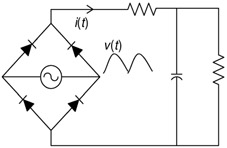
Conventional single-phase AC-DC rectification (Figure 10.1) was treated in Wu [10], who showed in that analysis, as was well understood in the past, that the input line current is pulsating and nonsinusoidal. This implies high harmonic contents and a low power factor. The former produces electromagnetic interferences and the latter gives rise to low-power transfer efficiency. It is therefore imperative to reshape, by some means, the input current such that not only is it in phase with the rectified source voltage but also sinusoidal in its time-domain profile with low harmonic distortion. That is the essence of power-factor correction, PFC.
In the old days, the objective was met by passive means, adding huge capacitor banks to the AC line. In contrast, modern techniques approach it through active means, employing a switch-mode converter and forcing line current to match the line voltage. We attempt to cover the topic by briefly going over some definition issues, then examine the fundamental theory for boosting the PFC, the output capacitor size, the boost inductor selection, high-power parallel operation, current sharing issues, startup considerations, output short-circuit protection, control issues, and three-phase PFC, in that order.
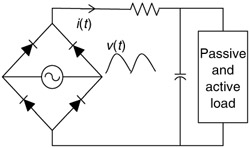
Given a circuit (Figure 10.2) that contains passive components and active switching devices and is driven by a single-frequency sinusoid, the instantaneous input power is given as
| (10.1) | |
The input current is expressed as a Fourier series because of the understanding that...