Switch-Mode Power Converters: Design and Analysis
The mathematical equation governing the capacitor behavior is given by
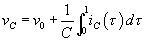
in differential form. It certainly can be placed in integral form:
Both equations give quite a few important insights:
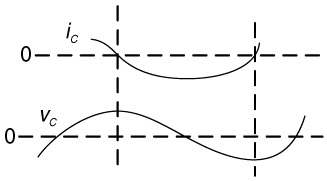
When i c = 0, dv c/ dt = 0. The latter signifies analytically the existence of extreme values for variable v c at the particular moment. In other words, v c_ max or v c _min occurs at the zero crossing of the capacitor current; figure follows:

Being the integral of the other variable i c (integrand), capacitor voltage lags behind the corresponding current.
The second fact also implies that the capacitor does not take in direct current for long. If it does, the terminal voltage exceeds its maximum rating and destroys its dielectric material.
Direct voltage does not contribute to the capacitor current. The capacitor blocks direct current.
The capacitor can be biased with a direct voltage.
The mathematical equation governing the inductor behavior is given by
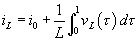
in differential form. It certainly can be placed in integral form:
Both equations give quite a few important insights:
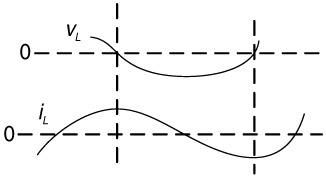
When v L = 0, di L/ dt = 0. The latter signifies analytically the existence of extreme values for variable i L, at the particular moment. In other words, i L_ max or i L_ min occurs at the zero crossing of the inductor voltage; figure follows:

Being the integral of the other...