Switch-Mode Power Converters: Design and Analysis
So far, we have focused our attention mainly on the power plant, the control modes, and the error amplifiers. No doubt these are important topics. But, without the supporting circuits, the power plant may not operate under optimal conditions For instance, the power switch may turn on or off in an undesirable manner, incur excessive losses (power dissipation), complicate thermal management, or reduce reliability.
With those in mind, in this chapter, we cover the bipolar switch drivers, MOSFET drivers, dissipative snubbers, lossless snubbers, feedback isolators, and soft start.
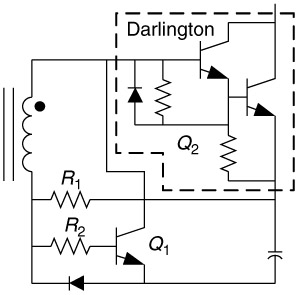
In the early 1970s, switch-mode power converters employed bipolar junction transistors as the main power switch exclusively, since MOSFET were not yet mature for power application. Bipolar transistor switches at that time, in general, also operated at switching frequencies of lower tens of kilohertz. The latter is attributed to the slower response time as a result of distributed junction capacitances in the bipolar transistor's junctions. More important, the bipolar transistors are current-controlled devices. Effective control of the transistor requires timely injection, or removal, of charge carriers (current) into, or out of, the base terminal. Figure 12.1 gives such a circuit, which was often named the transformer-coupled (-isolated) Darlington driver.
As shown, the Q 2 base terminal is driven by a rectangular waveform with two alternating states. Therefore, the circuit also switches between two alternating structures corresponding to Q 2 on and Q 2 off (Figure 12.2). During the on...