Switch-Mode Power Converters: Design and Analysis
Chapter 11: Error Amplifiers

Overview

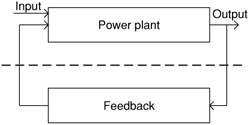
As shown repeatedly in the previous chapters, modern switch-mode power converters are closed-loop control systems in every respect. As such, they all can be represented at the most fundamental level by a block diagram (Figure 11.1) consisting of two interconnected key blocks: power plant (power stage) and feedback controller containing a high gain amplifier. So far we have focused almost exclusively on the closed-loop formulation without actually dealing with the amplifier design, except to represent the block with a symbol A( s) or EA( s). This by no means suggests that the block is unimportant or the task is easy. As a matter of fact, the past experience of many designers paints a grim picture on the subject. To many, the design process for the compensation amplifier component selection in particular is so intractable as to border on the trial and error that tends to give engineering a bad name. The question is this: Is it really so hard to do? In this chapter, we try to make it easier.


Figure 11.1: Typical converter loop partition

11.1 Amplifier Category

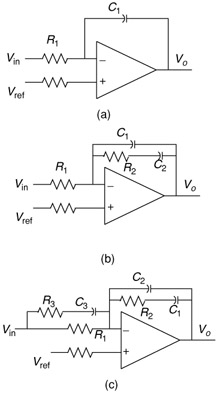
Compensation amplifiers come in many forms, the three most popular ones for general control-loop applications are given in Figure 11.2. Type I amplifier's transfer function is easily identified as

(11.1)

Figure 11.2: Amplifiers (a) type I, (b) type II, and (c) type III

The amplifier gives a -20dB/decade roll-off starting at zero frequency and a constant -270 , or 90 , phase. Type II amplifier's transfer function is given as

UNLIMITED FREE
ACCESS
TO THE WORLD'S BEST IDEAS

SUBMIT
Already a GlobalSpec user? Log in.

This is embarrasing...

An error occurred while processing the form. Please try again in a few minutes.

Customize Your GlobalSpec Experience

Category: Logarithmic Amplifier Chips
Finish!
Privacy Policy

This is embarrasing...

An error occurred while processing the form. Please try again in a few minutes.