
Centrifugal Blower Vacuum Pumps and Vacuum Generators
Last Updated: April 1, 2025
Description
Centrifugal blower vacuum pumps and vacuum generators are devices designed to move air or gas by converting rotational energy into energy in the fluid being moved. They are primarily used to create a vacuum or to move air at high flow rates.
Working Principle
Centrifugal blower vacuum pumps operate by using a rotating impeller to increase the velocity of air or gas. As the impeller spins, it draws air into the center of the impeller and then flings it outward through centrifugal force. This action increases the pressure and velocity of the air, allowing it to be discharged at a higher pressure. Vacuum generators, on the other hand, often use the Venturi effect, where a fluid's velocity increases as it passes through a constricted section of a pipe, creating a vacuum.
Applications
Centrifugal blower vacuum pumps are commonly used in applications such as wastewater treatment aeration, pneumatic conveying, vacuum lifting, air knives, and industrial drying processes . Vacuum generators are often used in systems where a quick and efficient vacuum is needed, such as in packaging, material handling, and automation systems.
Advantages over other Vacuum Pumps and Vacuum Generators
Centrifugal blowers are advantageous in applications requiring high flow rates with moderate pressure, as they are generally more efficient in these scenarios . They are also cost-effective and simpler to maintain due to fewer components, which reduces the risk of mechanical failure .
Limitations
One limitation of centrifugal blower vacuum pumps is that they may not be suitable for applications requiring very high vacuum levels, as they typically generate moderate pressure and vacuum levels . Additionally, side channel blowers, a type of centrifugal blower, do not have a stable characteristic curve and can have above-average energy requirements when operated at their performance limits .
Considerations
When considering centrifugal blower vacuum pumps and vacuum generators, it is important to evaluate initial costs, which can be lower for single-stage blowers due to their simpler design . Operating expenses should also be considered, as energy consumption can vary based on the specific type and application. Durability and maintenance costs are generally favorable for centrifugal blowers due to their simplicity and fewer moving parts, which can lead to lower replacement and maintenance costs over time .
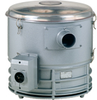
from Elmo Rietschle Gardner Denver Hanover, Inc.
Vacuum pumps F-CEVF (29). Volume flow. up to 5 m ³/min. up to 176.5 cfm. Multi-stage radial blowers for vacuum operation complete with filter and dust separator. The models F-CEVF (29) are suitable for removing paper powder and dust. Capacities up to 5 m ³/min (up to 176.5 cfm). Total... [See More]
- Mechanical: Centrifugal
- Configuration: Individual Vacuum Pump
- Vacuum Pump Type: Mechanical
- Pumping Speed: 11.8 to 2012

from Elmo Rietschle Gardner Denver Hanover, Inc.
Vacuum pumps G-BH 8. Volume flow. up to 950 m ³/h. up to 558,8 cfm. The G-BH8: Half as large – twice as strong. Volumetric flow up to 950 m ³/h. Differential pressure −550 mbar. Small design volume. Low weight. Energy-saving operation. Variable electronic speed control. [See More]
- Mechanical: Centrifugal
- Configuration: Individual Vacuum Pump
- Vacuum Pump Type: Mechanical
- Pumping Speed: 12.4 to 1441