
Reciprocating Piston Vacuum Pumps and Vacuum Generators
Last Updated: April 1, 2025
Description
Reciprocating piston vacuum pumps and vacuum generators are devices designed to create a vacuum by removing gas molecules from a sealed volume. These pumps utilize pistons that move within cylinders to displace air and generate a vacuum, effectively reducing the pressure within the system.
Working Principle
Reciprocating piston vacuum pumps operate on the positive displacement principle. They use pistons that move up and down within a cylinder, similar to the mechanism found in internal combustion engines. As the piston moves downward, it creates a vacuum by expanding the volume within the cylinder, allowing air to flow in. When the piston moves upward, it compresses the air and expels it through an outlet valve. This cyclical motion effectively reduces the pressure within the system, creating a vacuum. These pumps are particularly useful for achieving high ultimate vacuums, up to 2x10^-2 Torr, and are commonly used as backing pumps for more complex vacuum systems like turbomolecular pumps .
Applications
Reciprocating piston vacuum pumps are commonly used in roughing load locks in Molecular Beam Epitaxy (MBE) and Ultra-High Vacuum (UHV) processing systems . They are also suitable for analytical applications and leak detectors where a clean vacuum is required.
Advantages over other Vacuum Pumps and Vacuum Generators
Reciprocating piston vacuum pumps offer higher pumping speeds compared to diaphragm pumps, making them more efficient in applications requiring a clean vacuum . They are well-suited as backing pumps for turbomolecular pumps, providing a reliable and effective means of achieving the necessary vacuum levels for various industrial and scientific applications.
Limitations
These pumps are not suitable for pumping corrosive or abrasive media, which can lead to wear and damage to the pump components . Additionally, they may not be the best choice for applications requiring the handling of different gases at varying speeds, as their performance can be affected by the type and consistency of the gas being pumped .
Considerations
When considering reciprocating piston vacuum pumps, it is important to evaluate the initial costs, which can vary based on the specific design and capacity of the pump. Operating expenses should also be considered, as these pumps may require regular maintenance to ensure optimal performance and longevity. Durability is a key factor, as the mechanical components are subject to wear over time, potentially leading to increased maintenance and replacement costs. Accuracy in maintaining the desired vacuum level is crucial, and the pump's ability to consistently achieve this should be assessed.

from Ingersoll Rand Industrial Technologies / Air Motors
Engineered for compactness, economy and dependability –Ingersoll Rand ’s Vacuum Pumps are the number one choice for demanding applications, providing top operating efficiency combined with low maintenance. And best of all, these vacuum pumps are backed by Ingersoll Rand, the world... [See More]
- Mechanical: Reciprocating Piston
- Configuration: Individual Vacuum Pump
- Vacuum Pump Type: Mechanical
- Application: Industrial

from Gast Group
These rugged compressors offer oil-less operation to ensure the discharge air remains free of contamination from lubricants. They produce minimal noise and offer high flow, pulse free air - making it ideal for dry sprinkler systems. Wear items are easy to replace, which allows for a long service... [See More]
- Mechanical: Reciprocating Piston; Compression / Pressure Service
- Configuration: Individual Vacuum Pump
- Vacuum Pump Type: Mechanical
- Application: Industrial

from Champion
Reciprocating Air-Cooled Air Compressors- Vacuum. Pressure Lubricated, A-Series. The A-series reputation has been built on quality, reliability and accessibility to all components. Products include air-cooled bare compressors, boosters and vacuum pumps. A-Series pumps include heavy duty cast iron... [See More]
- Mechanical: Reciprocating Piston
- Configuration: Individual Vacuum Pump
- Vacuum Pump Type: Mechanical
- Pumping Speed: 198
from FS-Curtis
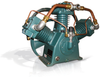
Vacu-Plus Series Vacuum Pumps feature cast iron construction which minimizes vibration during operation. Applications include bottle filling, vacuum cleaning, de-aerating, pump cleaning, dehydrating, feeding paper sheets, tank purging, leak testing, lifting liquids, milking machines, oil wells and... [See More]
- Mechanical: Reciprocating Piston
- Configuration: Individual Vacuum Pump
- Vacuum Pump Type: Mechanical
- Pumping Speed: 6.6 to 86