This volume is part of the Practical Guide Series developed and published by the ISA, the International Society for Measurement and Control. The Practical Guides were conceived because of a shortage of published material in the field of measurement and control that bridges the gap between theory and actual industrial practice. Many books in the field have catered to the needs of technical students, who need to be oriented to basic control theory and concepts, or college-level readers, who are interested in engineering mainly from a classroom perspective. There are handbooks for practicing engineers that cover measurement and control, but these handbooks often devote only a chapter or two to topics that merit more attention. Within the Practical Guides Series, separate volumes address each of the important topics and give them comprehensive, book-length treatments. Each book in the series can be understood and used by technical students, sales engineers, sales personnel, and managers, and relied upon by those who have "real-live" industrial concerns such as correct application, safety, installation, and maintenance. Another unique feature of the Practical Guides is the stress placed on the actual experience of measurement and control practitioners. The Practical Guides are overseen by various Volume Editors and a Series Technical Editor, who have extensive experience in measurement and control. The Volume Editors have been selected for their specific expertise in the volume topics, and bring together numerous Contributing Writers with even more specialized knowledge. The Series Technical Editor, who is responsible for general technical consistency within each volume and across all volumes, helps guide the Volume Editors. The Practical Guides capture the hard-earned experience of the writers and, by employing examples and recording anecdotal observations, make that experience as applicable for the reader as possible. Case studies, either hypothetical or based on real case histories, are used to illustrate typical situations and show how good planning and practical applications made the difference between success and failure. Some of this information has never been documented before. This volume is designed to be at home in a library, in a classroom, or on the plant floor. The comfortable reading style, large pages, and frequent illustrations will contribute to ease of use. The page design uses graphics to "call out" some of the major points of the text, such as crucial safety checks and important examples. Each Practical Guide gathers widely scattered information in a single text, with bibliographies directing the reader to other sources. |
 TABLE OF CONTENTS
 Chapter 8 - Control Valve Noise
This chapter discusses the practical acoustic noise aspects of control valves. Valve noise-generation mechanisms, prediction, and reduction information are covered. Control valve noise generation and the prediction of valves' noise levels are highly complex subjects and our understanding of them is still incomplete. Although our general knowledge may be somewhat incomplete, it is a testimony to the experts in the field that we have gained a reasonably accurate ability to predict control valve noise and find workable practical solutions for reducing it. Introduction Noise is considered by many to be the world's most prevalent form of pollution. Consider the following items:
All of these items show that noise is extremely detrimental to humans. Some have called it "a slow agent of death." The one end result that most often comes to mind is hearing loss and deafness. This type of noise damage is so subtle and insidious that by the time it becomes apparent, it is too late. The World Health Organization estimated a number of years ago that noise costs the United States more than $4 billion annually in accidents, absenteeism, inefficiency, and compensation claims. Of course, not all of this is due to industrial noise, but it certainly bears the lion's share. What is noise pollution? It can be defined as unwanted sound, or sound without value. Noise fighters fondly point out that the word apparently derives from the Latin nausea. Figure 8-1 shows a table of relative noise levels for common sounds and activities and provides a perspective for judging aspects of noise in our lives. 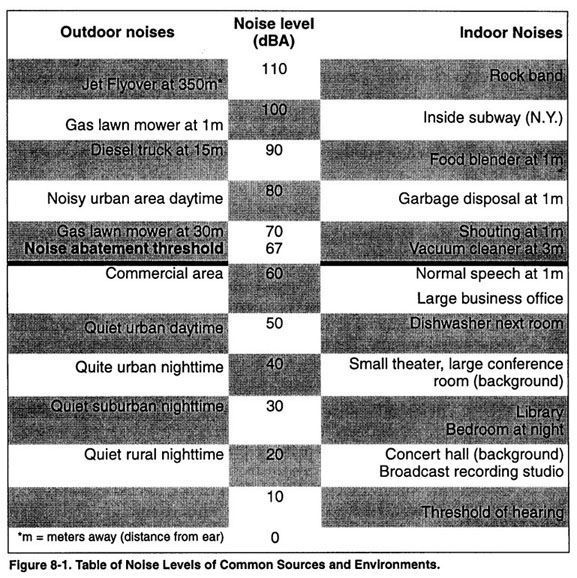 There are many noise sources in industrial plants, but major contributors are control valves operating under conditions of high mass flow and/or pressure drop, with gases and vapors. This aerodynamic noise is one of the few sources, and sometimes the only source, of noise levels exceeding 100 dBA, and in some cases up to 140 dBA About the only thing louder in normal operation is a rocket or aircraft jet engine at takeoff power. Being able to predict such valve noise problems in advance of valve purchase and then being able to generate corrective action are therefore vitally important. Control valve noise can vary from a low frequency rumble to a high frequency scream or screech, depending upon the basis of the noise being generated. For those not completely familiar with noise terminology, the decibel, or dB, is the most commonly used unit of measurement. The decibel measures a sound's intensity or, to the ear, its loudness. |