This volume is part of the Practical Guide Series developed and published by the ISA, the International Society for Measurement and Control. The Practical Guides were conceived because of a shortage of published material in the field of measurement and control that bridges the gap between theory and actual industrial practice. Many books in the field have catered to the needs of technical students, who need to be oriented to basic control theory and concepts, or college-level readers, who are interested in engineering mainly from a classroom perspective. There are handbooks for practicing engineers that cover measurement and control, but these handbooks often devote only a chapter or two to topics that merit more attention. Within the Practical Guides Series, separate volumes address each of the important topics and give them comprehensive, book-length treatments. Each book in the series can be understood and used by technical students, sales engineers, sales personnel, and managers, and relied upon by those who have "real-live" industrial concerns such as correct application, safety, installation, and maintenance. Another unique feature of the Practical Guides is the stress placed on the actual experience of measurement and control practitioners. The Practical Guides are overseen by various Volume Editors and a Series Technical Editor, who have extensive experience in measurement and control. The Volume Editors have been selected for their specific expertise in the volume topics, and bring together numerous Contributing Writers with even more specialized knowledge. The Series Technical Editor, who is responsible for general technical consistency within each volume and across all volumes, helps guide the Volume Editors. The Practical Guides capture the hard-earned experience of the writers and, by employing examples and recording anecdotal observations, make that experience as applicable for the reader as possible. Case studies, either hypothetical or based on real case histories, are used to illustrate typical situations and show how good planning and practical applications made the difference between success and failure. Some of this information has never been documented before. This volume is designed to be at home in a library, in a classroom, or on the plant floor. The comfortable reading style, large pages, and frequent illustrations will contribute to ease of use. The page design uses graphics to "call out" some of the major points of the text, such as crucial safety checks and important examples. Each Practical Guide gathers widely scattered information in a single text, with bibliographies directing the reader to other sources. |
 TABLE OF CONTENTS
 Chapter 22 - Computerized Control Valve Sizing
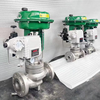
Most people recognize the importance of selecting the right size control valve for a particular application. Obviously, if the control valve is too small, it will not be able to pass the required flow. It is sometimes not quite so obvious that there can also be serious problems associated with selecting a valve that is too large. Besides the fact that a valve that is larger than necessary will cost more than a correctly selected smaller valve, an oversized valve will only use a small portion of its total stroking range and may operate for extended periods of time with the controlling member very close to the seat. A valve that only uses a small portion of its total stroke to control over the entire required flow range is likely to be unable to effect accurate control because of the effects of hysteresis and dead band. When a valve operates with the plug close to the seat, high fluid velocities between the plug and the seat are the result. If this condition is allowed to exist for extended periods of time, the valve internals are likely to wear prematurely because of the erosive effects of the high-velocity stream. In contrast to on-off isolation valves, which are normally selected to be the same size as the pipe in which they are installed, properly sized control valves are often one or two sizes smaller than the connecting piping. In recent years the task of sizing control valves has become more complex. The increased popularity of rotary control valves, with their high ratio of flow capacity to body size, dictates that the effect of pipe reducers on valve capacity and also on recovery factor and terminal pressure drop ratio cannot be ignored as it sometimes was with globe valves. Valve-generated noise has become a major concern, and the modern noise prediction techniques have become increasingly complex. As a consequence, anyone who needs to select, specify, or troubleshoot control valves would do well to have access to an adequate valve sizing computer program. This chapter lists some of the features that should be considered for inclusion in a comprehensive control valve sizing program and tells you how to construct Lotus 1-2-3 worksheets for performing sizing calculations for liquid, gas, and two-phase flow. The Development of Valve Sizing Aids In the earliest days of control valve application there was no such thing as "valve sizing." Control valves were simply selected to be the same size as the connecting piping. This practice gave way to various sizing calculation methods. Over the years, various methods have been applied to reduce the effort required to solve the necessary valve sizing equations. The earliest of these were nomographs and specially designed slide rules, distributed mainly by control valve manufacturers. These devices were actually quite accurate, although most of them were designed before the introduction of the ISA gas-sizing equations, which improved the accuracy of gas calculations, especially where high-recovery valves were concerned. Also, most of the nomographs and slide rules did not address the effects of pipe reducers or include noise calculations. The advent of programmable calculators, though not exactly "user-friendly," considerably simplified the task of performing repetitive complex calculations, and the author and a number of control valve manufacturers published control valve sizing programs for use with the more popular calculators [Refs. 1 and 2]. The Hewlett-Packard HP-41C with its alphanumeric capability and optional printer allowed the development of interactive and at least somewhat user-friendly programs, which could produce a printed record of calculations that included identifying the various inputs and calculated results along with appropriate engineering units. Now that powerful, relatively inexpensive personal computers are in widespread use there are a number of comprehensive control valve sizing programs available for these computers, distributed both by commercial software publishers and control valve manufacturers. Table 22-1 lists some of the suppliers of computer programs for control valve sizing. |  Control valves must be properly sized to ensure adequate capacity and accurate control. |