This volume is part of the Practical Guide Series developed and published by the ISA, the International Society for Measurement and Control. The Practical Guides were conceived because of a shortage of published material in the field of measurement and control that bridges the gap between theory and actual industrial practice. Many books in the field have catered to the needs of technical students, who need to be oriented to basic control theory and concepts, or college-level readers, who are interested in engineering mainly from a classroom perspective. There are handbooks for practicing engineers that cover measurement and control, but these handbooks often devote only a chapter or two to topics that merit more attention. Within the Practical Guides Series, separate volumes address each of the important topics and give them comprehensive, book-length treatments. Each book in the series can be understood and used by technical students, sales engineers, sales personnel, and managers, and relied upon by those who have "real-live" industrial concerns such as correct application, safety, installation, and maintenance. Another unique feature of the Practical Guides is the stress placed on the actual experience of measurement and control practitioners. The Practical Guides are overseen by various Volume Editors and a Series Technical Editor, who have extensive experience in measurement and control. The Volume Editors have been selected for their specific expertise in the volume topics, and bring together numerous Contributing Writers with even more specialized knowledge. The Series Technical Editor, who is responsible for general technical consistency within each volume and across all volumes, helps guide the Volume Editors. The Practical Guides capture the hard-earned experience of the writers and, by employing examples and recording anecdotal observations, make that experience as applicable for the reader as possible. Case studies, either hypothetical or based on real case histories, are used to illustrate typical situations and show how good planning and practical applications made the difference between success and failure. Some of this information has never been documented before. This volume is designed to be at home in a library, in a classroom, or on the plant floor. The comfortable reading style, large pages, and frequent illustrations will contribute to ease of use. The page design uses graphics to "call out" some of the major points of the text, such as crucial safety checks and important examples. Each Practical Guide gathers widely scattered information in a single text, with bibliographies directing the reader to other sources. |
 TABLE OF CONTENTS
 Chapter 10.21 - Control Valve Features: Valve Features to Reduce Noise
Valve Features to Reduce Noise Silencers and Diffusers A diffuser is a pressure reducing device that is installed downstream from a control valve. The total pressure drop needed for flow control of a flow control loop is divided between the valve and diffuser. This enables the valve to operate at a lower pressure ratio (?p/p1) and greatly reduce the control valve noise level generated by steam, gas or vapor flow. A properly selected diffuser valve combination can result in up to a 40 dBA noise reduction. The diffuser or silencer differs from other types of path treatments because it does actually absorb some of the noise energy. For control valve applications operating at high pressure ratios (?p/p1 greater than 0.8), a series approach, which splits the total pressure drop between the control valve and a fixed restriction such as a diffuser, downstream from the valve, can effectively minimize the noise. The diffuser must be designed for each unique installation so that the noise levels generated by the valve and diffuser are equal. Valve manufacturers that offer diffusers will design for the conditions. Diffuser and silencer design are covered in Chapter 8. 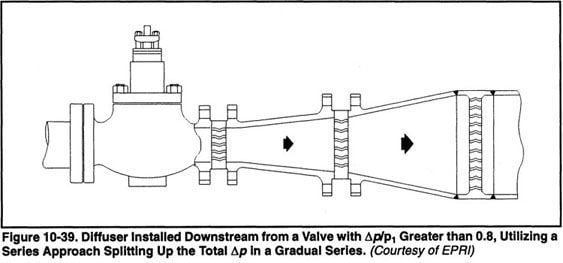 Vent Diffusers Control applications venting to atmosphere are usually very noisy because of the high ratios of delta p/pl and the excessive exit velocities involved. A vent diffuser or silencer may be used to divide the total pressure drop between the actual vent and an upstream control valve. A vent silencer and control valve combination can reduce the predicted or potential overall system noise by as much as 60 dba. Figure 10-40 shows a vent diffuser venting to atmosphere, downstream from a control valve. 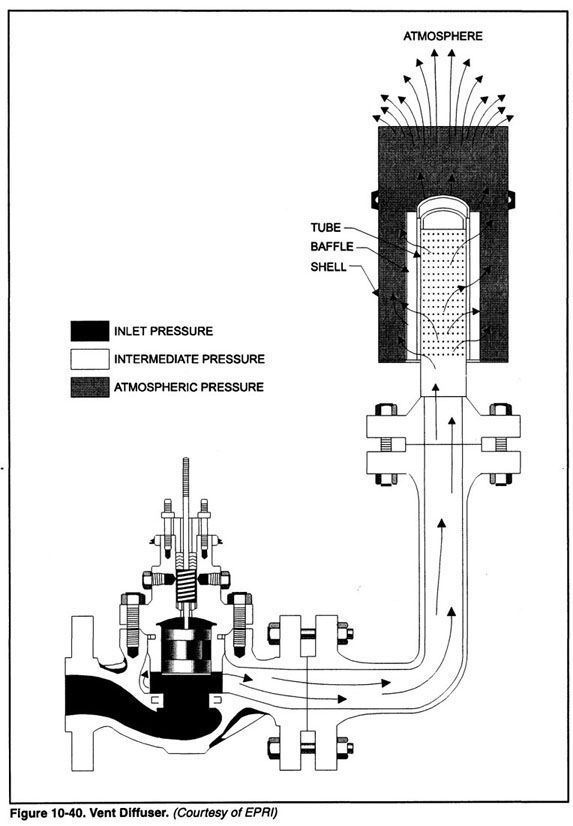 Noise Abatement for Butterfly Valves For rotary valves, noise attenuation devices are also available. Depending on the intended pressure drop ratios, a fixed restriction installation downstream from the butterfly valve, can consist of one or more stages of perforated plates. Its purpose is to absorb the maximum possible portion of the system pressure drop. 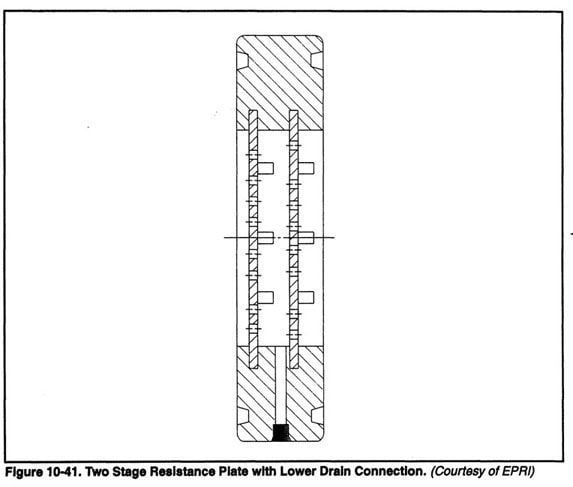  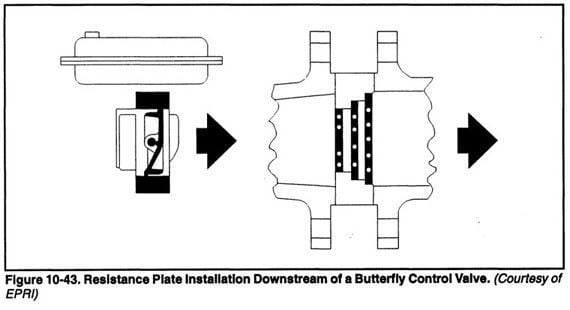 |